Embracing Freedom in Your 50s: A Journey of Self-Discovery

Something magical happens for women around the 50’s. Maybe it has something to do with the deluge of hormonal changes finally receding. Perhaps it’s the decades of life lessons filled with enough contrast to cause a blind person to see. It could be the loss we’ve accumulated in our psyches and experienced in our bodies.

Maybe it’s all of the above.

Regardless, whether it’s the tightness in your back each morning or the awareness that you are inching ever closer to the once-upon-a-time-retirement age, new generations arriving faster than Lucille Ball’s conveyer-filled chocolates, you wake up to the realization that you have a very important choice to make: to live with fear or freedom.
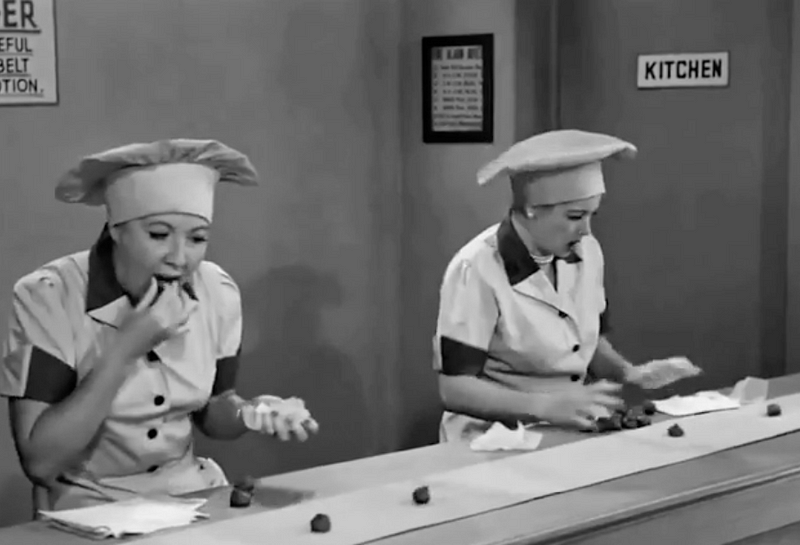
Lucille Ball and Vivian Vance struggle to wrap chocolate candies on a conveyer belt. (Credit: YouTube)

Your Pain — Only Part of the Story

Ever notice how when you have a slight cold or just feel meh and you head to work or an event that you feel you “can’t get out of?”

Typically, you feel better after attending whatever said public outing is. I believe this stems from what we are focused on: interacting with others, taking action and/or completing tasks.

The same concept of physical pain can be applied to our emotions. There’s a tendency for us to contract when we experience something negative. Our heart constricts. It’s no wonder we often say we feel “heartache” or that our “heart is breaking.”

But what we resist, persists. And the 50th decade of life has shown me it’s time to remove the already-falling-apart armor of the ego. Beneath the pain is the truth of who we are: unique, precious, divine, and wise because of those hard-won lessons.

The 50’s is a time of Michelangelo. 

YOU are the angel. Your life has brought pain and suffering, joy and ease — all of it to expose the gorgeous essence of who you were ALL ALONG.

AZ Quotes on Goodreads

Pain is but a teacher. It reminds us to pay attention. It guides us towards what matters: our authentic, imperfectly perfect selves.

The Real Story of You

I’m so thankful that I didn’t grow up with social media. Days were spent outdoors, playing hopscotch and roasting marshmallows with others. Community meant eye contact — sans a screen. On line meant you were literally on a line in a store. 

The convenience of technology is WONDERFUL. How lucky are those of us in our 40’s on up. We were given a sacred space to experience life more slowly, more digestibly. What a gift for us.

To arrive at this more than half century mark on Earth means that you’ve both witnessed and experienced humanity’s kindness and cruelty. 

What happens from this point forward is up to each of us. It always was, but age arrives with an awareness that we are all connected. That separation was always an illusion. 

Fear contracts and exacerbates pain of all kinds.

Freedom is a deep inhale. It looks within for peace and guidance. It honors experience, as just that: a moment of life living you, without attachment. It acknowledges pain but doesn’t identify with it.

Freedom means choice. Sure, the big choices like where to live and how to spend your days. 

But it also means, perhaps more importantly, the freedom to choose the smallest of things that make the biggest impact in a life: the freedom to choose how you relate to this world, to others, to challenges.

Life in the fifties has brought the gift of no longer looking over my figurative shoulder. I know I’m enough. And this knowing is reflected, again and again in the choices I make that are internally guided. Motivation is internally-driven. Self-expression reigns of utmost importance. And self-worth is derived steadily, wonderfully, from within.

If you want to know the story you are telling about yourself, tune into your inner dialogue. How are you speaking to yourself? With kindness or criticism? With blame or accountability? With honesty or rationalization?

The Earth School offers ample opportunities to reflect back to us where we are vibrationally. Self-compassion and self-worth are foundational to reflecting back a freedom-filled, authentic, and rewarding experience.

<a href="http://&lt;!– wp:embed {"url":"https://www.xiexperience.com/a/2148017638/PDyzpiBw&quot;,"type":"rich","providerNameSlug":"embed"} –> <figure class="wp-block-embed is-type-rich is-provider-embed wp-block-embed-embed"><div class="wp-block-embed__wrapper"> https://www.xiexperience.com/a/2148017638/PDyzpiBw </div></figure> Masati Healing and Wealth Mastery


The Bad Ass Mother: Make Way for Her

Inside every woman is a warrior. (Image created using CANVA)

While getting divorced, my lawyer hit on me.

“It gets very lonely at night. You’ll see. You deserve pleasure.”

He took my hand in his. And I removed it, gingerly, as one does walking away from a live, exposed wire.

I was a young mom, caught in the crosshairs of a legal system that gave power to those with deep pockets — regardless of concepts like justice and morality. My lawyer and his pinky ring held the key to the next door of my life.

Looking back, I realize I gave my former lawyer the key. I’d handed it to him on a vulnerable, insecure platter.

We become what we believe.

Life Reflecting Belief

The world is always mirroring to us what we believe about ourselves. Back then, I believed I received the poor treatment from my former lawyer that I deserved.

Boundaries were regularly crossed because I didn’t even think to have them. 

Low self-esteem does that. It creates a world of default assumptions, allowing a person to morph into prey. 

We cannot control the actions others take. But we can have agency for ourselves. Self-esteem builds healthy boundaries. It isn’t frightened to remove a hand from an unprofessional lawyer with highly manicured hands. A woman with strong self esteem is too busy being clear about what she wants to care one cent about the frail ego of another.

The Bad Ass Mother

Hallmark can show all the sappy movies it likes of mother’s being spoiled with breakfast in bed; commercials can advertise all the eye-catching merchandise to “spoil mom.”

 But what about every day of the year? What happens when the sun goes down and it’s status-quo Monday morning?

I am a Bad Ass Mother. I love myself. Really, radically love myself. Even when it’s hard. ESPECIALLY when it’s hard. And I invite you to do the same.

You don’t need to be a mother to mother yourself. You are a part of Mother Nature. You possess all the tools needed to grow your bad ass garden.🪴

Bling is nice. So are vacations. Beautiful clothing. Cars. Flowers. Gourmet meals. But none of it matters a bit without the womb of it all: self esteem.

With strong self esteem, you are naturally going to mother yourself. You won’t take crap from others. You will take steps in the direction of your dreams. You will not settle for breadcrumbs in your personal relationships. You will love yourself for doing things that scare the shit out of you but will allow you to grow. This is cause for a Mother’s Day celebration.

No one is coming to save you because no one else can do the work but you. 

A bad ass mom does what Mel Robbins says:

“Doing what makes you happy, being brave, taking risks, and following your own path will always be more important than other people’s opinions about it. This is YOUR life. Stop allowing what other people think keep you from living it.” Mel Robbins

Join me in being a Bad Ass Mom. Defiantly love every part of yourself — especially the parts you have the most trouble loving. Even the willingness to do so is a huge step.

The greatest relationship you will ever have is the one with YOURSELF. Radically give yourself compassion. Mother yourself like a bad ass. Know you matter.

And you’ll start to notice the world around you will reflect this inner change. That kind of self esteem and self acceptance is both palpable and contagious. It is emotional kryptonite for toxic people.


Embracing Change: Transforming Toxic Relationships

Knowing the keys to the kingdom are a “level up” sign. (Image created using AI on CANVA)

I recently returned from visiting with a close family member who suffers from frequent physical ailments. The pains themselves alter throughout her body but one constant remains: the shroud of negativity she carries. 

For years, we shared a co-dependent dance. She would complain, and I would morph myself to please her. It was a manifested tango of low self-esteem, each of us playing our roles beautifully: her the perpetual victim and me, the quasi-therapist who could “save” her.

It took many rounds in this particular Earth School classroom to understand I was a participant in the toxic tango.

But on this visit, I watched without reacting. I listened to her cries that she didn’t want to live anymore, her verbal attacks on everything from the weather to drivers on the road. I allowed myself to feel all the emotions that arrive when dwelling with someone who is negativity personified and manipulates to get what they want. 

My body reacted to what I observed with an upset stomach. Our vagus nerve — the longest cranial nerve — runs from our brain to our large intestine. This nerve literally means “wandering” in Latin and plays an important role in involuntary sensory and motor functions — including our digestion. I couldn’t “stomach” the negativity of this loved one.

And yet, I was able to observe it all:

🧘‍♂️ the negativity

🧘‍♂️the upset stomach

I chose to take deep breaths and go for long walks when possible. I chose to find the humor. I chose to look at this spirit having a physical experience. And here’s what I saw:

A woman who is in pain with her knee because she literally can’t move forward in life. She is too steeped in the illusion of darkness to find the light that is her and always there. I saw the child inside the woman, no different than a toddler trying to sneak in an extra cookie, playing a game to get love. I watched her manipulate behavior and words to garner attention.

I realized that I can choose to love her without the need for her to change.🤯

I Love You, You’re Perfect, Now Change

Part of the reason there is often great family tension during the holidays is the old, familiar patterns that resurface. Unaddressed — sometimes unknown — triggers surface across dinner tables.

That which hurts is the wound that is unhealed. Leveling up is about growing aware of our wounds, understanding its origins, and choosing to love anyway.

“When you can find joy in the midst of the scariest times, you know you’ve leveled up.” Brenda Grate

Loving this person who identified with a false sense of self, I leveled up. Loving myself and finding joy in the midst of her pain, I leveled up. Loving her essence, the little girl with unaddressed wounds, I leveled up.

We think of leveling up in terms of gaming or a career move. It’s a term we associate with improving or growing. This world is a matrix, a classroom for our souls to experience life as a human.

Each time we choose to see light in the midst of darkness, we are leveling up.

“No romance, amount of money, credential, or achievement can give you the sense of certainty your own joy can provide. When you practice having fun along the way, the Universe supports you.”-Gabrielle Bernstein

The keys to the joy we seek is inside of each of us. We can’t make someone else happy by making ourselves miserable. When we can find inner peace and joy from within, we are free from emotional vampires. And we can also choose to love those Downer Debbies.

Even letting the Universe know that you are willing to see a negative person or situation in a new way and surrendering this desire to the Universe is a leveling up step.

Heaven or hell is a state of mind. It is not dependent on people or places, financial or health circumstances.

Find your Heaven on Earth now by being the change you want to see in others.

XI Peak Meditation

To the Loved One You Can’t Reach

When the Shit Hits the Fan (Literally)

This past week, the shit (literally) hit the fan. 

You know those moments when you are holding life together by a flimsy strand? You think: “This is tough, but I got this.”💪

The self-pep talk renders you akin to a duck on the water. Sure, you look smooth on the surface, but you are paddling furiously just below the shallow current.🦆

Still, if you could hold it together for a tad longer, you think you can make it through the day/week/month without imploding.🤯

And then, the shit hits the fan…

While the aphorism is apropos of anything negative happening on a grand scale (where no amount of duck paddling will work) in my case, 💩 floated through the first floor of my home, a river of it swimming through like a feces canal.🤢

The short version of this smelly (true) story: a broken sewer line pipe caused the issue, and it’s going to cost a year of college tuition to repair (Let’s not even speak about insurance…).

What’s In YOUR Plumbing?🤔

Remember that duck analogy? Yeah, my waddle was already quacking upstream when the R.O.P. (River of Stool) hit. 

A home’s pipes are like the arteries in a body: everything’s connected.

I thought about this idea of connection a lot. Each of us is connected to each other in this world, on a micro and macro level. And those arteries, while not always physical, either close or open and sometimes need to be replaced altogether.

It was when the R.O.P. hit that I started to become aware of the R.O.P in a close relationship. My heart would always ache when I spoke to this person. Invisible cracks would start to form. I’d Band-aid the pain up with rationalization and distraction.

I was regularly this person’s quasi-therapist — a sounding board for her to throw her deluge of negativity my way. I’d sop up her violin music with emotional pompoms that I’d shake until she felt better.

But there’s a price paid for being someone’s emotional tsunami and it’s much higher than any insurance deductible.

It took my literal (sewer) pipes breaking to realize the shitstorm I was accepting in my personal relationship.

Waddling upstream, I could remain in the comfort zone of rationalization for this person’s toxic behavior.

But when I was at ground zero, emotionally, physically, financially and could no longer waddle upstream, I needed a lifeline. I was drowning.

And what did she do? She continued to do what she always does: she took out her violins and made the moment all about herself. She pulled out the “one up” card: “You think you have it bad. Let me tell you what I’m going through.”🙈

I wasn’t looking for anything more than a lifeline. A simple handful of words like “I’m so sorry.” or “That must be tough.”

Nope. Instead, she regaled me with violin music about how tough she had it today, yesterday, and always. It was all about her. I couldn’t reach her over her whiny notes. I realized then that the crap in my home was nothing compared to the emotional crap she’d been dishing me for years.

I’m in pain — much more about this relationship than my home. A pipe can be replaced. A house can be rebuilt. Money can be replenished. 

But our personal relationships…those are spiritual fingerprints. They touch our soul.

The emotional pipes cannot always be replaced. But they can be examined and if needed, reshaped and recycled so that the heart doesn’t continue to get broken. We can shift our perspective, through the aperture of compassion — for ourselves and those we love — recognizing that some emotional pipes cannot provide the oxygen our heart needs to thrive.

The Illusion of Love

And why we fall for it

I discovered boys at a young age. A generous portion of my teen years were spent choosing a different “crush” in each class — an unusually fun form of academic entertainment.

Each boy had a story: the tough guy who was misunderstood, the quiet one who spent his afternoons sketching seagulls at the beach, the funny boy who used humor to deflect pain that I daydreamed about healing.

And yet…

The narratives of each boy were more fictional than a Harry Potter series. 

They were surface tales that made me feel good to weave in my imagination.

Illusory Dating

But then, dating started. 

“He likes you.”

The three coveted words my riddled-with-hormones brain wanted to hear. It didn’t matter who the he was. What mattered: someone liked me.

My teens and 20’s were greatly spent looking externally for a sense of self worth.

The primary focus: what did they think of me?

It was secondary to consider how I felt about them. My value was tied to their perception of me.

When we look for merit or worth in another’s eyes, we give away our power.

When we hand over the invisible yardstick of worth to another, we lose ourselves.

There is often an illusion to dating — particularly in our youth: we believe the person we are attracted to is the cutest, sweetest, funniest or any other “est” qualities we find ourselves thinking. But who “they” are is just an illusion of what we want them to be.

One of the many boys I had a crush on was Zack — a sarcastic know-it-all, a “bad boy” with whom I shared an AP History class. Almost every day, Zack would come up to me, give me a playful smile that reached his blue eyes and say, “Can I have a quarter?”

Sometimes, I’d give him one; sometimes, I didn’t. The quarter was irrelevant in my 15-year-old-hormone-rattled brain. 

What mattered: Zach’s attention toward me — including those playful blue eyes. 

My focus was so consumed on his attention towards me — like a beggar starving for crumbs — that my heart began thumping like mad in my chest every time I saw his long legs make their approach to my desk.

And if he winked at me? Utter elation.

As a grown woman now, hindsight renders me shaking my head, a humorously sad smile on my lips.

Zack was a goofy kid with a lot of chutzpah. Maybe he thought I was cute; maybe he just needed money. He smelled like he hadn’t gotten the memo on deodorant — all sweaty and stinky from a mix of hormones and PE. He had as much experience at flirting as a fish living out of water. 

Dating in youth (crushes included) often includes two potential illusions:

  1. Creating a story of who someone else is.

and

2. Creating a story of who we are (in an attempt to please the other)

It’s no wonder so many of us in our early dalliances found heartache: we were dating an illusion, experiencing relationships based on false or incomplete narratives.

Illusory Love

Real love — that intangible experience humans crave and is written about in everything from songs to scripts, arrives like a crockpot meal: in time.

Intimacy requires trust — something acquired over time. But this is not just intimacy with another; at some point, love means intimacy with ourselves.

Illusory love is the couple that rationalizes they are “good” when the frowns in their faces speak a different story. It is the white picket fence of relationships that looks great on the outside, but you can’t help but notice the paint chipping when you step closer.

When we eclipse who we are to please another, it doesn’t matter how many years we’ve shared with a partner. Resentment and disappointment fill the cracks of the unstable foundation. 

An illusory love is the emotional equivalent of building a house on quicksand — it won’t last.

There’s a powerful quote from author Alice Hoffman that illuminates the why behind our seemingly irrational behavior to chose or remain in an unhealthy romantic relationship:

“Is it the man you want, or the feeling inside you when someone cares?”

When we remember the why behind our behaviors — particularly with love — we can better discern if we are with someone out of love or its illusion.

The late Maya Angelou once said:

“When a child walks in the room…do your eyes light up? That’s what they’re looking for.”

We are children in grown up bodies, hungry to matter, starving for connection. 

But the greatest connection, the most important relationship will ever have is the one with ourselves.

When we nourish ourselves, when we remember that our self worth is sourced from within, we are less likely to fall prey to an illusory love.

 The grounded feeling of knowing you matter prevents starvation and taking emotional crumbs from someone who is not in your best interest.

Looking for Sweet Revenge?

Playing dead is the sweetest step in the sweetest revenge.

Maybe someone betrayed you. Manipulated you. Lied. Cheated. Insulted.

Whatever the flavor, someone hurt you and now there’s a surging flood of anger in your veins. You. Want. Revenge.

The “R” Word

When we fill wronged by someone, we want justice. We want them to feel what they made you feel. We want them to pay for their mistreatment and misdeeds.

But when we hunger for revenge, do we really know what we are asking for?

The word revenge comes with that nifty little prefix at the front: RE

re: back or again

Then there’s that solid root word in revenge: VENGE— a Latin word:

venge: protect, avenge, punish

Did You Hear Yourself?

Do you know what you are asking for with revenge? (GIPHY)

So, when you ask the Universe for revenge, you are essentially asking to experience punishment or a sense of vengeance again.

Think of revenge as a wound you keep picking: it’s only going to grow more irritated and bloody with time.

Now what about this idea of venge meaning protection? Are you really protecting yourself when you are punishing someone else? The fact that you are doing so “again” sounds downright exhausting.

The Cat and Mouse Game

I get it: you’re hurt. Angry. Hungry for justice. But we’ve already established that revenge — the idea of punishing someone else — will only inflict more pain back onto you.

Revenge is a cat and mouse game. You are the mouse. When you seek vengeance, you are only making the cat claw at you more.

The only way to end the cat and mouse game: to play dead. To surrender to the injustice, cruelty, mistreatment, and any other terrible behavior of the someone who has hurt you.

When we surrender to the what is of someone’s awful behavior, we are no longer dependent on them for peace.

Make no mistake: abuse of any kind is unacceptable. I am not saying: Allow this person who hurt you to keep hurting you. On the contrary, I’m saying:

Live your life. Focus on things and people that bring you genuine pleasure and happiness.

The cat only has power if you allow it to. Each time you get into the ring with the cat, the game will only continue.

Get out of the ring. Play dead.

Then you can enjoy your life. And what a beautiful life it is. The sweetest revenge is living your best life, filling it with appreciation for even the smallest of things: the sound of birds outside a window, the air you fill your lungs with.

When we let go of the need to justify our anger, life’s sweetness returns.

And when you feel angry, let it out to people you trust.

Don’t go seeking understanding from the source of your pain.

This life can be amazing and awful. It’s up to you how you choose to perceive it. How sweet is that?

—-

Under Attack?

The Friendship Diet

Discover the connection between food and relationships in my book: The Friendship Diet

Behind the Curtain:

Life Backstage Tells a Different Story

The front row has nothing on the real drama backstage.

The other day I was venting to my sister about pressing financial matters.

“I guess I’ll just be working well into my 70’s.”

“You could be like those older ladies I see at Macy’s. They are at least that age and so adorable working there.”

My sister’s tone was genuine, making the delivery of her words sting that much more.

“Great idea! That’s always what I wanted to do late in life.” My voice dripped with sarcasm.

“I think it would be fun.” 

Now the gloves were off. Like a water hose finally unplugged, I unleashed my anger her way.

“Fun? How can you say that? Why the hell would I want to work at some meaningless job in retail out of necessity in my 70’s?!”

Behind the Curtain of Anger

My sister hadn’t done anything wrong. The anger I unfairly threw her way stemmed from a genuine fear of which her words had, inadvertently, fanned the flames.

Fear is the backstage entity often cloaked in anger. When we aren’t in alignment with ourselves, the slightest comment or action of another can be perceived as salt on a wound.

My sister had genuinely tried to comfort me. She, of course, could only do this from her own vantage point:

“I’d love to have a job like that someday. My career involves so much responsibility. I can’t imagine not working even after I retire, so doing something in retail part time would be fun.”

Wearing Someone Else’s Shoes Hurts

When we look for comfort from someone else, we need to remember that they:

  • only possess their own vantage point
  • are not responsible for the other person’s inner alignment

My sister can hear that I’m experiencing a fiscal crisis, but that is not the same as experiencing it. Likewise, I can hear my sister express her potential enjoyment at working in retail later in life, but I can’t make myself share this sentiment.

Asking someone to feel what you are feeling is like shoving your shoe onto someone else’s foot: it’s not going to fit and can be downright painful.

It’s important to know what you are asking for from that person in the first place. My sister was only sharing her thoughts on the idea of working in her 70’s.

 But I had never been clear about where I was standing: blazing, unfiltered fear.

Say Where You Are

I hadn’t acknowledged the intense fear and instead danced in front of the figurative curtain with haughty anger.

My attitude had been a defiant “Can you believe this bullshit?” but inside, behind the curtain, I was peeing in my pants.

How could we expect anyone to be there for us emotionally if we don’t tell them where we are emotionally?

Spend Time Backstage

After touring the backstage area of my psyche, I got real with the fear. 

When we spend time in the discomfort of fear, acknowledging its presence, and facing it head on, the fear itself dissipates. 

The fiscal situation is still there, but my spiritual awareness of the bigger picture has kicked in, and with it, I know that my health is the most invaluable gift there is and not worth sacrificing to the external (and temporary) reality.

Backstage is where fear likes to lurk; it is a stealthy entity, hiding behind anger. But when we face our fear head-on, peeling back the curtain to the what-ifs that plague our psyches, light pours in, leaving no room for fear to hide.

They Myth of Empathy: What It Is and Isn’t

The notion that empathy can deplete our mental resources or hurt us is an unarticulated myth.We can appreciate someone else’s suffering without the need to experience it.

A good friend has a car accident. Your uncle has dementia. A sibling has breast cancer. In each of these situations, as in any challenging time in the lives of loved ones, our heart has the opportunity to open and experience compassion.

But sometimes, we humans confuse Compassion’s powerful sibling, Empathy, for a virus that’s potentially contagious. 

So, we close up, emotionally distancing ourselves from whatever turmoil a loved one is experiencing, not because we don’t care, but because we are afraid to care too much.

Empathy Fear in Action

Years ago, a friend of mine saw I was struggling with a family issue. When I articulated what was going on, she told me the following:

“You know I love you, but I can’t be around you while you are going through this. It’s too hard for me. Once it’s over, let’s get together.”

Despite knowing me for years, my friend equated “being there for me” with somehow catching the challenges I was facing.

What Empathy is Not

Empathy is not something that requires physical, emotional, or spiritual stamina. It doesn’t ask us to drain our health, bank account, or time. Empathy doesn’t infringe or demand. It isn’t a cosmic paramecium, feeding off of us to help another.

What Empathy Is

The prefix EM means to put into or bring to a certain state. The root word PATHY means feeling or suffering. To have empathy to imagine what another feels in a given situation. We are imagining the Other’s experience, but we are not in the situation itself. Empathy is the emotional lubricant that allows humanity to connect. By putting ourselves in another’s shoes, we stimulate Compassion.

Empathy in Action

My friend’s fear of empathy ironically prevented her from experiencing it. When someone loses a loved one, when there’s a difficult divorce, when a family member is robbed — the greatest thing we can do for that person is be present. The sufferer does not expect their friend to BE in pain, only to acknowledge that it’s there.

Empathy is a silent or verbal acknowledgement to let the sufferer know they are not alone. It can manifest in anything from a homemade pie to a text, letting them know you’re thinking of them.

The Myth of Empathy

There’s this unspoken fear that demonstrating empathy, allowing ourselves to “go there” for someone in pain, is going to break us. 

But the opposite is true: when we open our hearts to someone else’s pain, our heart gets stronger, not weaker. Our ability to put ourselves in another’s figurative shoes makes us more powerful, not less.

A Surprising Benefit to Empathy

When we lean into empathy for another’s suffering, we strengthen self-compassion for ourselves. By welcoming the unwelcome in others, we grow more understanding and forgiving of our own imperfections and challenges.

A Different Kind of Love Letter

There’s something powerful about the written word–especially when those words are crafted with the intent to alter the present.

Last week, I had the pleasure of speaking with the insightful and engaging, Alicia Elatassi on her Podcast, Vibes by Alicia. While our dialogue focused on feeding ourselves emotional nutrition (the main focus of my book, The Friendship Diet: Clean Out Your Fridge, Get Real with Yourself, and Fill Your Life with Meaningful Relationships that Last), one of the great questions Alicia asked me was:

Where can young women find the willpower to stop accepting emotional crumbs and leave a relationship that isn’t serving them?

Enter Faith. A relatively easy quality to possess in spades when we are flying high, but something fleeting and hard to feel when we are in a bad place—physically or mentally.

Then I remembered the Love Letter I wrote to the Universe. I wrote about the qualities of a partner I wanted, writing the letter in the present tense—not the past or the future. The idea is to write the letter and read it aloud. There’s something powerful about putting your desires onto paper; something energy-shifting about giving voice to the qualities you see in someone before he or she has physically materialized. Since time is a human construct, what matters is consciousness. According to author Larry G. Maguire:

“It is by our perception only that things appear to be, and not to be…. In fundamental reality, there is merely everything existent in a single moment.”

Mini-quantum physic lesson aside, when we reflect on the qualities we want to experience in another partner, we are paying attention, we are going within for answers, we are getting real with ourselves. The qualities we are looking for will not be found on social media or even in your close friend’s Love Letter. This writing exercise is a Love Letter to YOU, a subconscious reminder that what you want matters.

The Love Letter to the Universe can be written whether you are single, married, divorced, or widowed—the current relationship status doesn’t matter because YOU are the common denominator. The Love Letter offers a kinesthetic check-in on what matters to you and what you want to experience.

But back to Alicia’s thought-provoking question:

Where can young women find the willpower to stop accepting emotional crumbs and leave a relationship that isn’t serving them?

An internal shift occurs when you write a Love Letter to the Universe. There’s this energetic knowing that the figurative winds have suddenly changed. Faith starts to flow. You can’t look at the list you’ve created and remain willing to accept emotional crumbs. The more you refer back to your list, the more difficult it will be to continue swallowing the status quo. There will come a point when that Love Letter for Mr. Right will feel more real than the boyfriend who stares at his phone throughout dinner.

The Love Letter to the Universe is a powerful honing device when you’ve found yourself living by default, accepting whatever empty calories come your way. When we list the qualities we want in a partner, as if they’re already here in the flesh, we stop settling. We get comfortable walking away from what doesn’t serve us, discovering the very qualities we want in another, in ourselves. And when we love ourselves, we never starve.

Alicia’s Vibes Podcast: https://www.audible.com/pd/Vibes-by-Alicia-Podcast/B08JJM9S9B

The Friendship Diet:  https://www.amazon.com/Friendship-Diet-Yourself-Meaningful-Relationships-ebook/dp/B089GZJ5B5

Source: https://larrygmaguire.com/does-time-exist/

Dating Myth: The Closing Window

The idea that a woman’s potential to meet a man “before the window closes” creates a fear that manifests in unhealthy choices.

*Ann recently went on a date with a 5’9” man. At the end of the evening, the man said, “I like you. You’re cute. I’d like to see you again. But you’ll need to ditch the heels. We can’t have you looking taller than me.”

Ann is 5’ 8” sans heels. Apparently, Ann’s height directly affects her date’s ability to…er date her (or at the very least, stand beside her in public).

“Were you attracted to him?” I asked.

“He owns his own real estate company and drives a Lamborghini.”

“But are you attracted to him?”

She sighed and made a face like one would when offered leftovers from two nights ago. “It’s different at my age. You’ll see. You have to consider different things than you do in your 20’s and 30’s. So, he’s sensitive about his height and he seems a little needy. But he likes me, and he wants to take care of me. I don’t want to be alone. I need someone like him.”

Our talk went on, covering everything from his clean teeth to his affectionate texts. Still, my friend never did answer the attraction question. 

Ann’s divorce isn’t final. She has three girls to raise and at forty, she says “a woman’s window closes quickly. A man has plenty of time. The window remains open for them.”

But I boldly disagree with my dear friend. The “closing window” is a myth, an illusion perpetuated by the cousin of FOMO (Fear of Missing Out). This fear causes women and men alike to make choices out of some invisible pressure cooker. It is up to each of us to recognize the myth and do what YOU think works best for YOU, not what the mythical fear whispers (if not screams).

I am not stating that compromise isn’t a part of dating and personal relationships in general. But there is a fine but distinct difference between compromise and settling, between choosing to be with someone out of interest and choosing someone to purely have a “someone.”

Love can be found in the least expected places by people at any stage of life. And while the hunger to experience that love is real, there is nothing lonelier than spending time in the wrong company. 

*Name is altered to retain privacy.