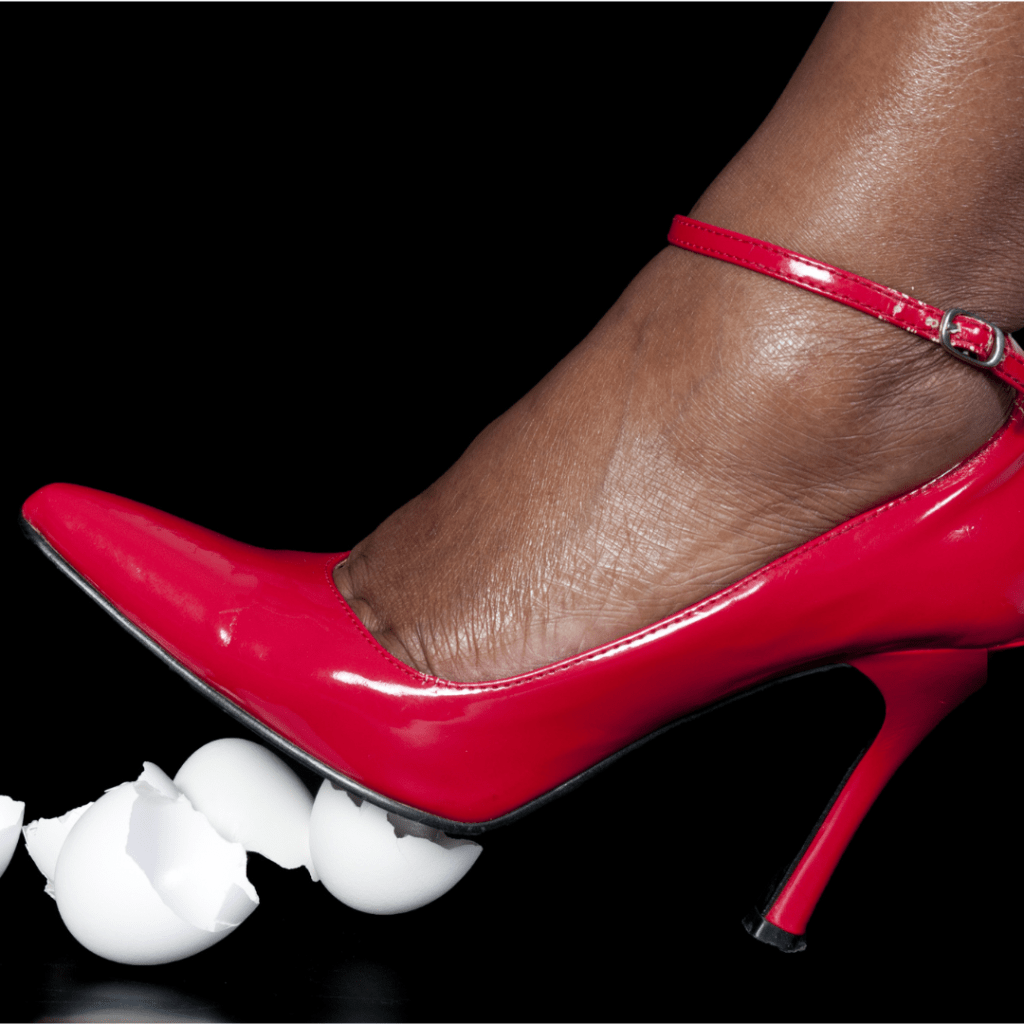
Walking on Eggshells?

When we tiptoe around someone to please them, we hurt ourselves much more in the process.

Intimidations. Threats. Manipulating facts. These are some of the tactics an abuser uses to maintain their control.

I know because I’m on the receiving end of it right now. Have been for over 7 years. It’s only getting worse.

Abusers are often the Sirens found in mythology: they woo their victims until they don’t know what hit them.

I think of a victim of abuse as a lobster in a pot, the heat slowly getting turned up, until they are boiled alive.

If you recognize the pattern I’m about to share with you, I strongly advise you to do whatever you can to get out of that simmering pot.

The Early Years

The love-bombing commences. The romance. The remembering of small details, the overflowing with thoughtfulness. The feeling that you are starring in your own Hallmark movie.

You’ve just entered the pot. The water is warm. It feels so damn good.

Sure, every once in a while the abuser will say something that gives you pause. But you are so in love with this person by now, you rationalize the pause away. You make excuses for some minor controlling behaviors.

The Middle Years

Welcome to life inside the pot that is now starting to feel very steamy.

Still, your Abuser is so good to you. Well, except when they’re not.

As the water starts to simmer, you find yourself feeling a little uncomfortable.

Because you’ve been in the relationship for a fair amount of time at this point, you’ve lost your way. Up is down and down is up.

Being in an abusive relationship is living like Alice down the rabbit hole. Nothing makes sense.

What’s worse, you don’t trust yourself any more. You’ve lost your inner compass, your sense of what’s wrong and right.

Besides, it’s not that hot in the pot. There are even days when it still feels good. So long as you don’t upset the Abuser who put you in the pot in the first place.

Abusers and Eggshells

Eggshells are delicate and can easily break. Abusers are the eggshells. Once we are past the love-bombing phase, it becomes the victim’s unspoken job to ensure they don’t hurt their “delicate” partner.

Well-worn phrases by Abusers are steeped in manipulation and guilt:

  • If you hadn’t done __________, I wouldn’t be in such a bad mood.
  • You are so naive. There’s no way you can do/handle ____________.
  • I treat you like a child because you act like one.

You may be told what clothing you can and cannot wear. What foods you can and cannot eat. You may have a curfew, even though you are an adult.

Again, guilt is a weapon to keep the victim in place:

“I only do this because I care about you, and it’s my job to protect you.”

Freedom’s Price

When I finally realized I was a lobster boiling in that pot, I did everything I could to get out of the relationship.

Abusers don’t like to lose. Especially ones without the capacity for self-reflection.

It’s years since I left my abuser. Years since I had to walk on eggshells in his presence.

Unfortunately, the attacks are still coming. When you have deep pockets and are an abuser, there are creative ways to continue bullying someone.

The price of freedom doesn’t guarantee the end of attacks.

But it sure beats losing your life to a boiling pot.

Freedom Over Eggshells

Looking back, I don’t recognize the woman I was with the Abuser. She was constantly walking on eggshells to please the Abuser.

Walking on Eggshells:

  • never satisfies the abuser
  • only hurts the victim of abuse more

Better to walk on those damn eggshells and be true to yourself.

When you realize that the abuser WANTS their victim to be fearful, guilt-ridden, on-edge, and gaslit, you start to wake up your inner compass.

So crack some eggs, walk with your head held high, embrace your beautiful self.

No, we can’t control what an abuser will do, but we are now free to live life on our terms.
The Subtle Signs of Control

There’s often an unconscious mindset, a spiritual sleepwalking involved in the unspoken agreement between the controller and the controlled.

*Dana started making jewelry as a hobby. But the designs she gave to family and friends were so well-received, they began asking Dana to sell her creations. Within a year, Dana’s hobby was a part-time successful business.

            Unfortunately, Dana’s husband didn’t like his wife’s success.

            “A hobby is one thing but now it’s taking away time from our family.”

            Dana stopped selling her jewelry.

            *Brian dreaded calling his mother each day. He knew her judgement and disappointment were waiting for him on the other end of the line, knew he would be insulted within five minutes of the call. 

            “If I don’t call her every day, she freaks out, says she’ll call the police if she doesn’t hear from me. It’s just easier to call her and get it over with.”

            While Dana and Brian are two different people and genders experiencing different relationships, both are people in a controlling relationship. Like the metaphorical story of the frog that’s slowly boiled to death, Dana and Brian are in hot water, living a spiritual death each day.

            Controlling relationships manifest in all forms: romantic, friendship, family, and professional. Like the allegorical frog that is put in a pot of water that, ever so slowly, gets warmer, we can often miss the early, subtle signs that we are about to experience a “slow death.”

            Whether you are wondering if you are in a controlling relationship or about to start one, there is always the opportunity to wax reflective and consider the following warning signs:

  • Do you often feel like you are walking on figurative eggshells with this person?
  • Do you find yourself second-guessing your feelings regarding things this person does or says?
  • Do you find yourself agreeing to “get along” (think of the “Ostrich in the sand” mentality) with this person?
  • Do you feel guilty for privately resenting this person?
  • Have you found yourself altering your lifestyle (i.e. your choice of clothes, diet, faith, friendships, career, politics, etc.) to “make peace” or “satiate” this person?

Dana stopped selling her jewelry to make her husband happy. But just like the frog who sits in water that gets warmer and warmer until its boiled alive, Dana’s decision to please her husband before herself is an ongoing theme in their marriage: like the frog that doesn’t notice the subtle increase in temperature, Dana slowly rationalizes that “it’s not a big deal” that she wears high heels because he wants her to, or cooks lamb for him when she is a vegetarian, or receives an “allowance” from him because he’s informed her that she just “doesn’t have a head for numbers.” While Dana is a physically alive woman, in many ways, she’s no different than that boiled frog.

            Brian’s consistent cortisol spikes around the need to please his mother, usurping his own needs for hers, has long term effects on his biochemistry. An adult man, Brian has the power to decide how often he calls his mother. He can get out of the boiling water any time. But like our metaphorical frog, the Appeasement Game has been in place for years, so he thinks he’s forever trapped in that pot.

            Getting out of the pot isn’t necessarily easy. In fact, getting out of that water will feel downright cold, if not plain frightening. But that is the price of freedom—a gift and right deserved for everyone.

*Names have been altered to retain the privacy of individuals.