Understanding Reality: Beyond What Meets the Eye

Reality isn’t as solid as it seems

What do you see? (Image by author)

Early morning or late at night? My brain was confused as I took in the photo my son texted.

Factually, he’d told me the picture was taken on a Saturday evening. And the smattering of stars to the left made my cerebrum eager to confirm this.

And yet. The bright light in the center of the wispy-clouded sky told me it was early morning, in the wee hours of dawn.

“But that’s the sun.”

“No, that’s the moon.”

Wait…what?

The same sky from a different angle. (Image by author)

The Fact is…What?

Intellectually, I know that the moon will sometimes look bright because it reflects light from the sun, and that the moon itself does not emit any light. And yet, my brain couldn’t compute the bright circular light against the fair blue sky to be anything other than the sun.☀️

Our brains love certainty. They love to predict, compare, and plan. They deserve a gold star for their tenacious effort to keep us safe.

But the fact is, reality isn’t as solid as it seems. And when we allow our well-meaning brains to run the show, we can lose out on wonderful possibility.

When we allow our beautiful brains to assume, we miss out on considering life from another perspective, another angle. The fact is:

💡the sky is violet in color, not blue

💡dark matter makes up most of the Universe (85%) yet remains invisible

💡humans spend about 10% of waking hours with their eyelids closed(blinking)

💡The Earth is not perfectly round (It has a slight bulge around the equator)

Of course there are MANY more mind-blowing facts and that’s the point: when we keep the doorway open between science and perspective, our reality alters — something that tends to make our brilliant brains feel uncomfortable.

But something wonderful happens when we allow ourselves to dwell in the space between fact and perspective: we find opportunity where there once was lack, we find possibility where before we only saw impossibility, we find wonder where before there was status quo.

Each of us arrives with a unique set up fingerprints, formed at 3 months in utero. No two of us are alike as are no two tongues alike (Yup! There are actual tongue prints forensics will use.🕵️‍♂️)

Our well-meaning, extremely beneficial brains will continue to compare and look for similarities and patterns, predicting and planning in an effort to keep us alive. And that’s all good. But we mustn’t allow our brains to hijack our wonder, our curiosity, and the potential for seeing life through a different lens.
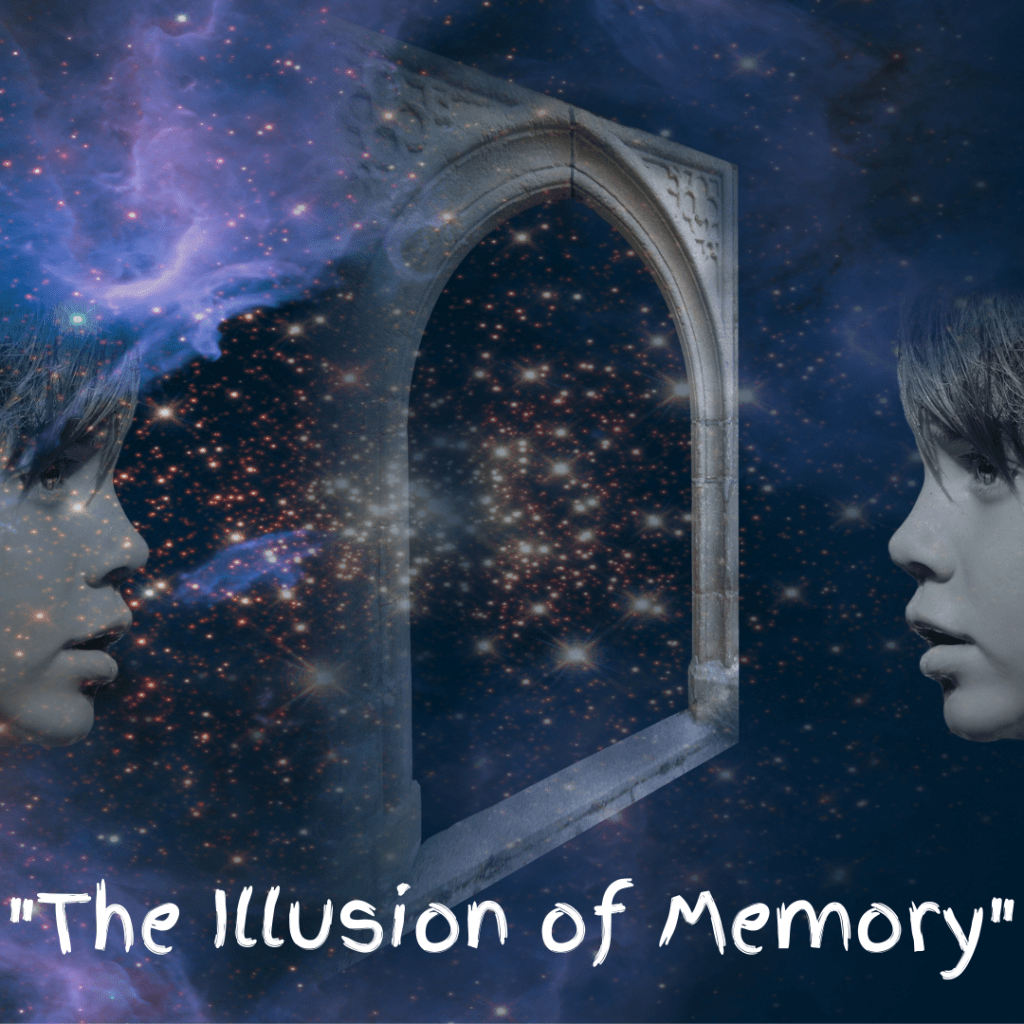
The Illusion of Memory

Psychological scientist and author, Dr. Julia Shaw, studies what she refers to as “false memories” that “corrupt our identities, politics and justice system.” It is our perception of the past that forms our emotional story and sometimes, even facts.

My father is just shy of his 8th decade on earth. He’s “been around the block,” filled with a lifetime of experiences that has caused him to grow, like all of us, physically, mentally, and spiritually.

Yet ask him about his collection of baseball cards from the 4th grade and he’s still there, sitting in Mrs. Kofkin’s class, watching the thin, pinch-faced woman snatch his cards away from him.

“She never gave them back,” my father says, a flood of emotion in his voice.

Psychological scientist and author, Dr. Julia Shaw studies what she refers to as “false memories” that “corrupt our identities, politics and justice system.” It is our perception of the past that forms our emotional story and sometimes even facts:

“Everyone thinks that they couldn’t be tricked into believing they have done something they never did, and that if someone were telling them about a false memory, they would be able to spot it. But we found that actually, people tend to be quite susceptible to having false memories, and they sound just like real memories.” (Dr. Shaw, UCL Psychology and Language Sciences)

This idea that we can falsely believe something that didn’t happen to us or that we never experienced directly fascinates me. So, I asked my father recently to share his well-told childhood experience with Mrs. Kofkin again.

“What did Mrs. Kofkin look like?”

“I don’t remember. But she took those cards from me. They were my cards. They weren’t hers to take. She just grabbed them from me.”

It occurred to me that the details of his memory weren’t important; what mattered was the feeling provoked—after so many decades—from the memory itself.

It was the feeling of the event that made all the difference, that kept his childhood “violin song” playing. I thought, this isn’t even about a stack of baseball cards from 7 decades ago. There’s something more here.

“Was Mrs. Kofkin mean to you?”

“No…she was just doing her job.”

“Who are you upset with then?”

(And here it came.)

“My parents. They knew how much those cards meant to me. I begged them to speak to my teacher and get them back. But they said they didn’t have time.”

So, there it was: my father’s memory that stirred a feeling of pain wasn’t about Mrs. Kofkin or the baseball cards. The teacher and cards were an illusion, preventing this almost 80-year-old man from seeing the source of the hurt: the message from his parents that his needs and wants didn’t matter.

We talked more about his parents not realizing they were hurting him, that they were busy running a store and doing, like most parents, the best they could. The pain they caused their son wasn’t personal or intentional.

One childhood memory and a world-altering perception to digest.

Yes, our perceptions create our reality, but our past perceptions do so as well. Our memories are like the wake of a ship, offering a trail of perceptions that buoy us along to the ever present. We have the power to consider that trail and perceive it through a different lens and by extension, shift the course of our present and future.

So, the next time you find yourself beating the drum of a past unpleasant or even traumatic event, dive into that memory until you unearth something you didn’t notice before. You just might find a perceptual treasure to steer you in a more peaceful, promising direction.

Sources: https://www.sciencedaily.com/releases/2020/04/200408085517.htm

The Gift of an Appetizer

Appetizer Accomplishment Thinking Increases Our Motivation to Get-Stuff-Done!

I’m a single Mom, a full-time teacher, an author, an actor—on camera and on radio. Whew, even just writing that sounds fatiguing! And why is that? Because we all know that each role comes with a generous serving of responsibilities and there are just so many hours in the day!

My family and friends have asked me, “How do you do it?” Did I mention I am a yoga and ballet barre enthusiast as well?

We all have those 24 hours in a day; we all need to sleep; some of us have less commitments than others, but have you ever noticed you get more accomplished with less time?

I refer to the taking-Time-by-the-hands mindset as “appetizer accomplishments.” You know, those mini-quiches or hotdogs in a blanket? They aren’t exactly a meal and they aren’t dessert either. They are these micro dishes of food meant to give one a sample, a little taste. If you’ve ever found yourself ravenous at a wedding or other formal event, you know the power those appetizers have to stave off your hunger pangs and normalize your blood sugar again. 

Appetizer Accomplishments work in a similar way: they offer a sense of getting-stuff-done without feeling overwhelmed or lazy. Much like their edible counterpart, the Appetizer Accomplishment helps keep us going.

Here is one of today’s Appetizer Accomplishments: I washed the shower faucet—no scrubbed the shower faucet today. Didn’t do the entire shower stall or the bathroom itself at all. Nope—I just had time for one area of domestic cleaning today (It looks fantastic, BTW). And now when I walk by it, admiring its shiny surface, I’m already motivated to scrub the shower door tomorrow.

Another Appetizer Accomplishment: I secured a team meeting with the core group of teachers I work with. This took less than five minutes.

Another Appetizer Accomplishment: I wrote back a dating site that is interested in having me write another blog piece for them. Again—this took less than five minutes.

There is a power in momentum. Each action builds upon itself, creating a cumulative effect in both our outer and inner reality. Appetizer Accomplishment thinking keeps us in a delicious zone: fostering our sense of purpose while simultaneously preventing burn out.

I challenge you (and would love to hear from you, to choose one Appetizer Accomplishment you could experience right now.