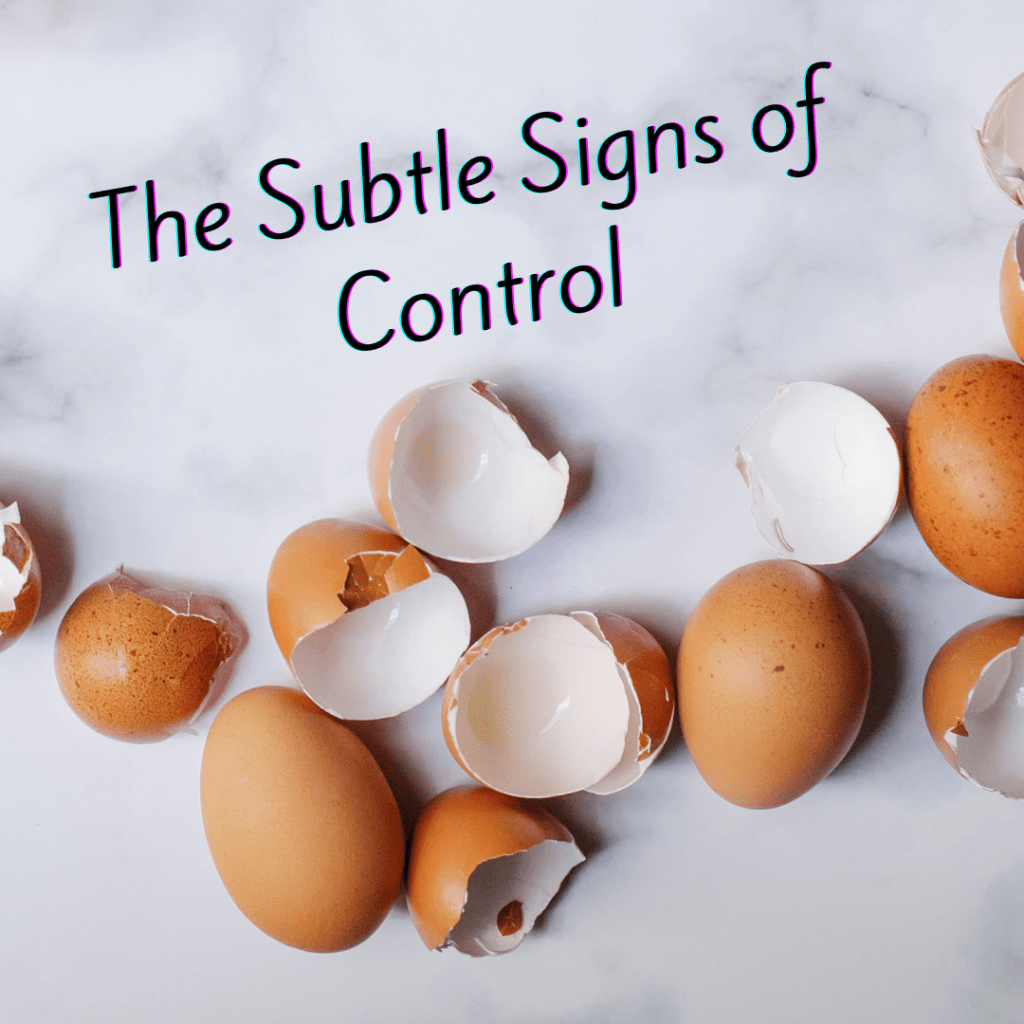
The Subtle Signs of Control

There’s often an unconscious mindset, a spiritual sleepwalking involved in the unspoken agreement between the controller and the controlled.

*Dana started making jewelry as a hobby. But the designs she gave to family and friends were so well-received, they began asking Dana to sell her creations. Within a year, Dana’s hobby was a part-time successful business.

            Unfortunately, Dana’s husband didn’t like his wife’s success.

            “A hobby is one thing but now it’s taking away time from our family.”

            Dana stopped selling her jewelry.

            *Brian dreaded calling his mother each day. He knew her judgement and disappointment were waiting for him on the other end of the line, knew he would be insulted within five minutes of the call. 

            “If I don’t call her every day, she freaks out, says she’ll call the police if she doesn’t hear from me. It’s just easier to call her and get it over with.”

            While Dana and Brian are two different people and genders experiencing different relationships, both are people in a controlling relationship. Like the metaphorical story of the frog that’s slowly boiled to death, Dana and Brian are in hot water, living a spiritual death each day.

            Controlling relationships manifest in all forms: romantic, friendship, family, and professional. Like the allegorical frog that is put in a pot of water that, ever so slowly, gets warmer, we can often miss the early, subtle signs that we are about to experience a “slow death.”

            Whether you are wondering if you are in a controlling relationship or about to start one, there is always the opportunity to wax reflective and consider the following warning signs:

  • Do you often feel like you are walking on figurative eggshells with this person?
  • Do you find yourself second-guessing your feelings regarding things this person does or says?
  • Do you find yourself agreeing to “get along” (think of the “Ostrich in the sand” mentality) with this person?
  • Do you feel guilty for privately resenting this person?
  • Have you found yourself altering your lifestyle (i.e. your choice of clothes, diet, faith, friendships, career, politics, etc.) to “make peace” or “satiate” this person?

Dana stopped selling her jewelry to make her husband happy. But just like the frog who sits in water that gets warmer and warmer until its boiled alive, Dana’s decision to please her husband before herself is an ongoing theme in their marriage: like the frog that doesn’t notice the subtle increase in temperature, Dana slowly rationalizes that “it’s not a big deal” that she wears high heels because he wants her to, or cooks lamb for him when she is a vegetarian, or receives an “allowance” from him because he’s informed her that she just “doesn’t have a head for numbers.” While Dana is a physically alive woman, in many ways, she’s no different than that boiled frog.

            Brian’s consistent cortisol spikes around the need to please his mother, usurping his own needs for hers, has long term effects on his biochemistry. An adult man, Brian has the power to decide how often he calls his mother. He can get out of the boiling water any time. But like our metaphorical frog, the Appeasement Game has been in place for years, so he thinks he’s forever trapped in that pot.

            Getting out of the pot isn’t necessarily easy. In fact, getting out of that water will feel downright cold, if not plain frightening. But that is the price of freedom—a gift and right deserved for everyone.

*Names have been altered to retain the privacy of individuals.

The Ghost and Ghosted

There’s another side to ghosting that is often overlooked but needing our attention.

*Jackie liked her date the way you appreciate a jacket on a cold day: He was comfortable but not someone she saw herself with. However, by the end of their dinner, he expressed he was “smitten” with her.

Despite knowing her attraction to him held a verbal equivalent of “meh,” she felt—what many of us feel at times—an inexplicable pressure to give him another chance.

On the second date, the distance between Jackie’s lack of attraction and her date’s attraction for Jackie had grown. 

“When can I see you again?”

Jackie could feel her throat tighten, unable to find the ability to say the words aching to form:

Look, there is not going to be another date for us. I think of you like a brother. End of story.

Well, that’s what Jackie wanted to say. Instead, she said:

“Yeah, let me look at my calendar.”

She dodged a kiss with a yawn.

Jackie is a divorced mom with 3 daughters who works full time as a neonatal nurse. She barely has time to date, but the time she spends dating is nothing compared to the physical and mental hours wasted, pretending there is potential with someone. 

A people pleaser, Jackie decided to text Mr. Smitten and tell him she met someone (a lie).

            “I thought that way, I could enjoy a potential friendship with him.”

            Mr. Smitten called her immediately, his voice sounding like someone losing a limb. “Oh man, did you really meet someone else? Oh man. That hurts. But can we be friends? I mean, I’m really attracted to you, but I promise to stay in my zone.”

            Again, Jackie could feel the tightening in her throat. She wanted to say:

What is the point of us developing a friendship when we both know you want more? 

            Instead, Jackie agreed to meet Mr. Smitten for lunch the next day.

            When we try to live for others, altering our lives to satiate others, we are doing two detrimental things:

  1. Telling ourselves (and the world) that we don’t matter.
  2. Hurting the very people we are trying to “protect.”

If Jackie allowed her truth to come out, it would be kind to both parties. Something simple yet direct like:

You seem like a great person, but unfortunately, I didn’t feel that x factor that is so important in a potential romantic relationship. I wish you only the best.

There’s often this unspoken sense in the digital world that the words we use don’t have an effect on people looking on the other end of the screen. Perhaps this is a common reason people in the dating world (and otherwise) “ghost” someone. But people pleasers are just as likely to ghost someone—not wanting to face the potential disappointment they will cause the other party.

Jackie didn’t ghost Mr. Smitten. She lied to him and herself, hiding behind a story to prevent dealing with the potential fallout of truth. In a way, she became a ghost to herself, rejecting the idea that she mattered.

Mr. Smitten deserved to know there was no romantic potential, so he could move on and meet someone who felt about him the way he once did about Jackie.

We humans are wired to avoid pain and discomfort, so it’s no surprise that ghosting offers a “quick fix” to avoid dealing with the potential anxiety that comes with confrontation. But there’s that other, more clandestine side of ghosting we need to watch for as well: lying to ourselves and by extension, the other person in the dating equation. It’s better to rip off that emotional Band-aid now than string someone along, hurting two people in the long run. 

Each of us matters. When we remember this, we stop lying to ourselves and others. The desire for truth eclipses fear of confrontation—the real ghostbuster;-)

*Name changed to protect privacy.

Our Brain’s Mad Lib

Ironically, knowing our brains’ tendency to focus on the negative is the key to a happier life.

            He was cute—really cute. A mop of dark hair with the sweetest brown eyes. For weeks, my friend talked about her new coworker, the one who asked if she wanted to meet after work sometime.

            The date was set for a Friday on a Tuesday. From Tuesday on, *Samantha could barely sleep or eat. 

            “I’m so nervous. What do I wear? What if he only meant for us to get together as friends? What do I say? What if he changes his mind and isn’t attracted to me?”

            The day finally arrived. I assumed I wouldn’t hear from Samantha until later that night. But Samantha called me before the sun even set.

            “You okay?”

            “Yeah,” Samantha said. Her voice made me think of tires losing air. “I’m not attracted to him.”

            Say what??

            “He’s not much of a conversationalist. I tried to engage him. He was so boring.”

            “Back it up sister, you thought he was so cute. What happened?”

            “He took off his mask.”

            Well then.

            We may not be in Samantha’s shoes, but we have certainly all experienced what psychologists refer to as negative bias. Our brains receive external information and literally wire the positive and negative input into different hemispheres.

            “Negative emotions generally involve more thinking…information is processed more thoroughly than positive ones. Thus, we tend to ruminate more about unpleasant events—and use stronger words to describe them-than happy ones.” (Stanford Professor, Clifford Nass)

            So, while Samantha was thrilled that the cute guy at her office asked her on a date, her brain was flooded with its Mad Libs’ tendency to fill-in-the-blank what ifs with worst case scenarios. Her brain’s negative bias created a rush of worrisome thoughts that manifested in difficulty sleeping and a loss of appetite.

            I had my own negative bias: when Samantha called me when she was meant to be on the date, my brain did its own Mad Libs negative bias: Did “cute guy” stand her up? Did he do something inappropriate? Is she in danger?

            The idea that Samantha just might have decided to end the date early didn’t occur to my brain. 

            But what about how “really cute” Samantha’s coworker was? There’s negative bias there, too. Afterall, a good portion of her worry stemmed from a fear that “really cute” guy wouldn’t find her attractive. So, her brain took the meager view one third of a man’s face and made him a Greek god, out of her league, aesthetically “above” her. 

            It’s important to realize that it was Samantha’s brain creating the Mad Libs in the genre of a horror movie. It’s also important to remember the brain is an organ—no different than the lungs or kidneys. The brain has specific functions just as our bodies’ other organs, but it need not define us.

            So, knowing our brain is wired toward the mental gymnastics of negative bias, what can we do? The Buddhist monk, Henepola Gunarantana suggests a compassionate reckoning of sorts with yourself:

            “Somewhere in this process [self-analysis], you will come face-to-face with the sudden and shocking realization that you are completely crazy. Your mind is a shrieking gibbering madhouse on wheels, barreling pell-mell down the hill, utterly out of control and hopeless. No problem. You are not crazier than you were yesterday. It has always been this way, and you just never noticed. You are also no crazier than everybody else around you. The real difference is that you have confronted the situation they have not.”

            Becoming mindful, cultivating self-awareness—including our brain’s hardwired tendency to focus on the negative, is actually the key to mental freedom. The challenge isn’t our negative thoughts; the challenge is remembering that we can choose not to believe them; the challenge is remembering we are not our thoughts.

            Source: https://skillpath.com/blog/positive-fight-natural-tendency-focus-negative

Before You Choose Your New Year’s Resolution…

Motivation is the fuel needed to keep us tackling our goals. Learn how to unearth this often ephemeral feeling.

Each year we see the psychic slate wiped clean for us, the calorie count set back to zero, the goals written neatly at the top of our agendas in colorful, promising ink. Whether it’s learning a new language or giving up nail biting, a New Year brings a highly marketed opportunity to dazzle us with motivation, to “improve”, to grow, to challenge ourselves, to be the best version of ourselves.

But something happens just days or weeks after each New Year. The shiny can-do determination felt in the Auld Lang Syne song (thank you, Dougie MacLean) sounds distant, the once heady anticipation of a New Year looks daunting on the other side, the conviction felt with the palpable count down around the world now seems like a pipedream, the reality of Time marching on with the same challenges before the magical New Year’s Eve.

So how can we sustain motivation long past the bells and whistles of New Year’s Eve? How can we keep chugging along towards the very things we find downright hard? How can we stave off the onslaught of intoxicatingly-convenient-and-must-less-painful excuses in the weeks and months to come?

Many are familiar with the baby step philosophy: taking those small steps that lead to big changes. And while that works fantastically well for many, this doesn’t address the core issue for sustained change: motivation.

My book, The Friendship Diet, explores the metaphor of food and personal relationships: we are starving for affection, we can fall prey to Diet Coke denial with the people we love, we find certain things our partner says or does distasteful. But the diet isn’t only about our romantic relationships. It’s about knowing our hunger, the why behind the things we do with everyone from our partner to our boss.

So, before you ring in the New Year with your mental (or physical) to do list of resolutions, ask yourself a couple of important questions:

  1. Why do I want to do these things? (i.e., lose weight, learn Tai Chi, give up smoking, adopt a dog, take up gardening, etc.)
  • How will my life be different with these changes?

The why is the oxygen supply of motivation. The how challenges our assumptions and potential roadblocks.

For example, let’s say you want to lose weight.

The why may be because you want to look and feel good in your body.

How your life would be different requires you to get specific and real with yourself. It’s no longer enough to think in cliches—not if you want to stay motivated. The more detailed your list here, the more likely your goal will manifest.

So, imagine how a life with weight loss would look and feel. Maybe it’s easier to get in and out of a chair, or you’re no longer out of breath when you take the stairs. Maybe it’s feeling sustained energy throughout the day. Maybe it’s donating your former-sized clothing to Goodwill. Maybe it’s the healthy annual physical report from your internist.

I recently went through this exercise with a colleague regarding her goal of weight loss and the how of her resolution plan brought up a roadblock:

“I can’t give up my clothing. If I give it up, I know I’ll start putting on the pounds again.”

Going through the how caused my colleague to run smack into something she didn’t want to acknowledge. But if we don’t digest the why and how of what we want to change, we are unlikely to remain motivated. 

Thinking we can gain weight simply by giving away our former size is magical thinking. We are all susceptible to irrational logic like this when we delve into the potential landmine of how. The key is to recognize the mental panic for what it is (our brains valiant effort to protect us) and stay the course.

And the why behind our motivation offers a conduit to potential discomfort as well. After all, the reason behind wanting to lose weight might stem from a childhood memory of bullying and bear no reality on the present. My colleague can still hear the taunts of a kid in school call her “Pillsbury Doughboy.” By tuning into the why behind her weight loss goal, she gained awareness of the potential tricks our minds can play. 

“I can still remember my cheeks burning every time he called me that.”

Naming the why, dispels the false narrative. Naming the why allows us to better tackle the potential hurtles of the how (i.e., donating her now baggy clothes to Goodwill). Any negative emotion (i.e., shame) from the past does not need to journey with us into our present or future. And when we can change the feeling behind an experience, our resolution potential is limitless.

Wishing you and healthy and rewarding New Year:-)

Sheri

Want to Face Your Fear?

Most modern-day anxiety is a by-product of our ancient brains. Like the whac-a-mole game, the mind’s alarm system is doing what it’s designed to do. Discover what happens when you don’t play the game.

There are countless tips and tricks to consider when it comes to overcoming a fear. Everything from imaging exposure to the big “F” to taking it on the anxiety-producing source in increments.

Let’s say you have a fear of elevators. You might imagine pressing the button to the elevator, hearing the doors swoosh open, and stepping inside the machine, all while you remain at home. Or perhaps you stand in front of the elevator one day and the next, press the button to go on, observing any anxiety that shows up (i.e., a racing heart, sweaty palms, etc.) with each increased exposure.

Whatever tactic you choose, there are two things worth noting:

  1. You have to SIT WITH any discomfort to overcome said fear.
  2. The fear isn’t real.

Fear is generated by the thoughts we think based on the experiences we have. Fear is your mind playing tricks on you in order, (so the mind falsely, well thinks) to protect and help you survive.

There are those who love a scary horror flick and loathe the idea of public speaking. Yet both activities manifest some kind of adrenaline. It is the mind’s interpretation of each event that makes all the difference, determining which you perceive as fun and which as frightening.

The brain is an organ, no different than the heart or kidneys. It has a job. It thinks. Our ancestors depended on the mind to protect us, flooding us with flight-or-fight catecholamine activity to help us survive a grizzly bear heading toward us. 

But we are no longer living as our ancestors did. There are no wild beasts coming after us as we sleep in a field. Our brains, however, have not adopted to our modern-day world of indoor plumbing and central air. 

Our brains aren’t cruel. They are like puppies with a new chew toy. As Dr. Amy Johnson writes (author of Just a Thought):

Our minds are “a very smart machine that isn’t always wise, but it loves you.”

Fear can’t sit still when you face it. It changes form. The emotion we feel is real, but the thought behind it can change. You can talk to your busy mind as you would an overtired child whose had too much sugar:

“I know you [mind] think I’m in danger, but it’s really okay. I got this.”

If you sit long enough with the fear, the fear will morph into something new. The fear of touching an elevator button will change to the fear of getting on the elevator to the fear of allowing the elevator doors to close. Your mind will continue to generate new ways to protect you since that’s what a mind does.

Discomfort shows us “psychological experience is being mistaken for something solid, personal, and true…. When we get lost in our mind’s narrative and temporarily forget who-we-are, which we often do, we feel discomfort. Discomfort is the built-in alarm that alerts us to our misidentification.” Dr. Amy Johnson

Take comfort in the discomfort; allow your beautiful mind do what it is meant to do, knowing it is manufacturing worst-case-scenarios to unnecessarily protect you. Watch it compare, compete, create negative bias, warn, exaggerate, and sit with any negative sensations that may arise within your body. You’ll know you’re on the right track when you notice new fears pop up. Just like the original fear, your higher self knows they are all illusions.

*Source: Just a Thought: A No-Willpower Approach to Overcome Self-Doubt and Make Peace with Your Mind

Did You Hear Yourself?

Something as simple as paying attention to the words we frequently use can potentially alter our psychological and even physical states for the better.

Next week, my aunt will take a plane trip with her adorable eight-pound dog. For the past few months, the “meat” of our conversations has involved her dog:

“I’m so nervous. I’m not sure the dose is enough to make her [the Maltipoo] sleepy for the plane, but I don’t want to give her too much.”

“I’m worried she [Maltipoo] will get sick on the plane.”

“I’m scared TSA is going to change their ruling and say she [Maltipoo] weighs too much, and then they’ll make her go in with the luggage.”

My sweet aunt’s focus on her adorable canine is understandable. Yet, I wonder if she ever noticed the Robin’s egg blue of the sky in late August or the turning of the leaves in October. Chances are, her tapestry of fear and worry prevented her from enjoying the giggles of her grandkids, or the aroma and taste of her morning java.

Last week, I counted the number of times my aunt used words connoting fear around her dog. This was a 10-minute conversation. How many times did she utter fear-based language? 8. Here were her words: scared, anxious, anxiety, concerned, and worried. These were highlighted and interchanged with qualifiers like awfully, terrible, worst, and horrible.

My aunt is a kind woman who wears her heart on her sleeve. She cares, often so much so, that she loses sight of her own wellbeing. She literally loses her mind to the things we can’t control (i.e., the upcoming plane trip with her Maltipoo).

When we focus externally on the world around us, without taking stock of how we interpret it, we can lose our way. Hyper-focusing on the what ifs in our external world prevents us from appreciating where we dwell in the present.

Scientists have long written of our inability to multitask:

“We’re really wired to be mono-taskers, meaning that our brains can only focus on one task at a time….When we think we’re multitasking, most often we aren’t really doing 

two things at once, but instead, we’re doing individual actions in rapid succession, or task-switching.” Dr. Cynthia Kubu

So, my aunt may look like she’s washing the dishes, or playing with her grandchildren, but she’s really not there. She is distracted by the what ifs, focusing on the very thing that is neither here nor in her control.

The topic of my aunt’s hyper-focus of what ifs is currently her dog, but the subject has changed over the years: a friend’s cancer diagnosis, the pandemic, the presidential race, personal finances—you name it, she’s articulated it in detail and at length.

Regardless of the topic, it is one steeped with those fear-connoted words above. The effect of those words on her psyche is powerful and ranges from insomnia to overeating.

There is a power we all possess in the way we interpret the world around us and the words we use. Even if my aunt doesn’t believe it, a simple shift in mindfulness, in focusing on what is literally in front of her, can help stave off her what if Doomsday scenarios. Since we can’t focus on more than one thing at a time, wouldn’t it be better to notice the sound of the rain outside your window than the idea of something terrible happening in a future that hasn’t arrived?

Mindfulness helps us slow down and recognize the words we use both aloud and silently. Here’s a quick exercise to see mindfulness in action:

While you’re reading these words, become aware of your forehead. Is it tense or relaxed? Notice your shoulders, are they back or rolled forward, loose or tight? Take a moment to breathe into your forehead, your shoulders—even your jaw. 

How do you feel? Chances are, while you were focused on the activity above, you didn’t worry about feeding the dog, responding to an email, or second-guessing what you said to a colleague yesterday. You were blissfully present.

When we are present, we appreciate more, we slow down, we become aware of the words we and others use. Listening to ourselves and other—not just hearing but truly listening—is a powerful honing device for the soul.

 Source: https://health.clevelandclinic.org/science-clear-multitasking-doesnt-work/

The Silent Thanksgiving Guest

The silent Thanksgiving guest is with you always. You bring this guest with you to the table. It is with you during the holidays and beyond. It is YOU, the observer, growing aware of your mind’s interpretation of experience.

Thanksgiving always conjures up the image of tables laden with ruby cranberries and plump, caramel-colored turkey, replete with pumpkin pie. Family is gathered around the table, hands extended to pass a generous bowl of sweet potatoes. A cozy fire flickers in the background as laughter bubbles up around the autumnal room.

Well, that’s the image anyway. The Hallmark-meets-Williams-Sonoma-catalogue of the idea of Thanksgiving. The Norman Rockwell of family, of loving comfort and filial security.

The reality is often quite different. According to a poll by the American Psychological Association:

“Nearly a quarter of Americans reported feeling ‘extreme stress’ come holiday time.”

The reality can involve anything and everything from experiencing the recent loss of a loved one to not getting along with your in-laws yet having to break bread with them.

The change in routine, the potential long-distance travel, the anxiety-provoking reunion with family members—some or all of the external factors can make the cozy image of Thanksgiving morph into a Haunted House of horrific possibilities, where you will be thankful for just surviving the family gathering.

So, how can we experience the feeling those Folger’s House coffee commercials exude around the holidays?  And what are those feelings anyway?

According to coach and speaker, Dr. Amy Johnson, feelings are our interpretation based on the interplay between our left (thought) and right (feeling) brain:

“…feelings are fluctuations of energy to which our mind attaches words and stories. Our left-brain interpreter labels and defines the energy dancing through us. So, when we talk about feelings and emotions, we’re experiencing two things: the movement of energy plus our mind’s commentary on that energy.” Dr. Johnson, Just a Thought

Let’s apply Dr. Johnson’s left-right brain awareness to a potentially stressful Thanksgiving situation now. Your flight to visit your family is delayed. You speak to your aunt on the phone to let her know about the delay.

“You’re not going to make it?” she asks.

“I don’t know. The flight’s delayed.”

“Are you wearing your mask? Are people wearing masks there?”

“Yes.”

“This is terrible.”

“I’ll call you when I know more.”

“Yes, call me as soon as you know.”

You recognize words (left brain) that come to your mind when you reflect back to the talk with your aunt: judgmental, anxious, bossy.

You recognize feelings: tired, nervous, frustrated. 

But now, aware, you can interpret your feelings a different way. You don’t need to tell the same habitual story about your aunt and her effect on you. You can interpret your feelings as excitement to see your aunt and her frustration at the situation as a hunger to see you. 

Remember: our heart races when we are on a roller coaster and in physical danger. It’s our interpretation, our mind’s deciphering of the left-brain language our mind uses that makes the difference.

Thanksgiving, steeped in years of familial habits—er, traditions, offers a powerful opportunity to practice Dr. Johnson’s mindfulness while in the company of loved ones who just might (inadvertently) push a habitually hot emotional button (or two). 

So, when you find yourself stressed about how moist the turkey is or upon hearing the banter in the family room grow louder with politics, go inward, and consider a different interpretation for the energy you are feeling. The labels we give our experiences aren’t “real”; it’s only the mind “doing what minds do” that makes it feel real. Each of us has the power to create a different interpretation.

The silent Thanksgiving guest is with you during the holidays and beyond. It is YOU, the observer, growing aware of your mind’s interpretation of experience. You can make peace with this guest at any moment—not just this November 25th. Figuratively break bread with your mind’s interpretation of what you are experiencing. Our feelings manifest in our body as energy; when we consider our left brain labels through a different lens, we can change our very experience.

Source: https://www.claritychi.com/holiday-stress/

What’s Your Story?

          There’s a major player in our lives that is unseen but real: our inner dialogue. The way we perceive a situation creates our experience to that situation. The way we speak to ourselves affects the world around us.

The other day, my friends drove about twenty miles for us to meet for lunch. When I asked them how the drive was both simultaneously responded:

            “The traffic was horrible.”  

              “It was good.”

            One car, one trip, and two completely different experiences.

            We can see these alternate reactions from a young age. A mother tells her children they can’t have a cookie now. One child howls, like something heavy landed on her foot, the other shrugs her shoulders and continues playing in the figurative (or literal) sandbox.

            Then there’s the difficult, harrowing experiences, like those who lived through and experienced life in a concentration camp during World War II. The inhumane conditions of life at Auschwitz; the incomprehensible cruelty, abuse, violence, and firsthand witnessing of genocide caused many to lose the will to live. Then there were those survivors like Elie Wiesel who wrote:

            “We are all brothers, and we are all suffering the same fate. The same smoke floats [gas chambers] over all our heads. Help one another. It is the only way to survive.” -NIGHT

            Wiesel was only fifteen when the Nazi’s deported him and his family to Auschwitz-Birkenau—only fifteen when, on their first night in the camp, his mother and younger sister were killed in the gas chambers. And yet, his spirit spoke of helping others, of survival, of help as the oxygen for their survival.

            Many Holocaust victims did not find helping others as a means to survival. Many victims were lost in incomprehensible fear and depression. Same situation but a very different experience again. 

            What causes us to react so differently to similar situations? What causes one person alone on a Saturday night to feel sorry for himself and another to relish his own company?

            A major player is unseen but real: our inner dialogue. The way we perceive a situation creates our experience to that situation. The way we speak to ourselves affects the world around us.

            Take a moment to think about something that happened today. If an unpleasant experience arose for you, consider the following:

  1. What were you thinking about the situation at the time?
  2. Is it possible you could consider perceiving the situation differently?
  3. If you answered yes to #2, how does the alternate perspective(s) make you feel?

   When we grow mindful of our inner dialogue, we are less likely to fall prey to negative thinking and more likely to experience compassion for ourselves and others.

Where Are You?

When we react to another’s drama, we run the risk of losing ourselves.

You know those days that make you feel like you’re walking outside on a soap opera set? The sky is the color of a robin’s egg, the air feels fresh and smells like autumn. That was today.

Unfortunately, the picture-perfect weather didn’t prevent two people in their cars at an intersection from fighting. My car idled just behind one of the cars as the drama unfolded.

One man got out of his truck.  I couldn’t hear him, but his arms were flailing. The other man got out of his car, a menacing expression with some kind of metal pipe in his hand.

My stomach and shoulders tensed up, and I felt a prickly heat across my chest. 

My teenaged son beside me looked calm, gazing at the scene before us with the aura of a modern-day Yoda. 

“Mm…I wonder who got there first.” He said with the pondering stillness of a Buddha.

The men were standing close to each other now. The tension between them fierce.

This is how it happens. Death by stray bullet. Gunfight at intersection, news at 11…

The above is where my mind went. I felt a strong, irrational urge to tell my son to duck. 

“It doesn’t really matter who got there first,” I said.

And just like that, the angry men returned to their cars, and we made our way to the intersection, the tense moment behind us.

Hours later, I am thinking about today’s tense moment. In a way, I wasn’t much different than these angry men: I wasn’t enjoying the beautiful day, I was lost in a moment of what if anxiety—another flavor of negative emotion. It was only my son who could observe the scene without taking it in.

We go through our daily lives, exposed to a myriad of “angry intersections”—moments when our environment is tense. At those moments, we can observe but we don’t need to react or become the stressors around us. Easier said than done. My son helped me realize that I’d stopped observing and started reacting; his non-reactive reaction reminded me that we all have this choice within us. 

When we try to detach and observe—even the negative reactions around and within us—we spend more time living in the moment. We can enjoy the beautiful day without getting sucked into another’s angry intersection.

A Dish for the Soul: Empathy

Dr. Pearcey, a Cognitive Psychologist at the Institute for Spirituality and Health, offers humanity a powerful tool for cultivating empathy.

The world feels more divisive than ever. Whether it’s how to handle COVID-19, the environment, the economy and everything in between, there’s a great deal of polarizing opinions. Yet there’s a fine but distinctive line between having an opinion and holding a grudge against someone for possessing an opposing, alternate viewpoint.

Our newly instated President Biden is palpably aware of the charged air. He asks us to put aside our differences, “uniting to fight the foes we face.” (Source: Vox).

We—a small but powerful pronoun. We are all together; humanity is interconnected in this mysterious life. We affect each other on levels great and small.

The charged air, the divisiveness and polarized opinions with metaphorical haunches raised (and sometimes literal, as we witnessed on January 6th at the Capitol), is fear-based reaction. Underneath the anger and violence is fear and pain. The lashing out is a manifestation of untended to psychological wounds.

Enter Dr. Jeremiah Pearcey, a Cognitive Psychologist at the Institute for Spirituality and Health (www.spiritualityandhealth.org) who offers “education and guidance…helping people reduce stress.” The other week, in honor of Martin Luther King Jr., Dr. Pearcey offered a mindfulness meditation to explore the historical moments leading up to the Civil Rights Movement, cultivating a greater understanding and compassion for others and ourselves. The title of the Zoom event: “A Day of Embrace and Peace.”

The idea of embracing the historical moments leading up to King’s famous “I Have a Dream Speech,” of finding peace in the face of tension seems like an unlikely pairing. Yet the wise Dr. Pearcey’s guided meditation is just what the world needs now.

After several cleansing breaths and a reminder to get comfortable, attendees of the conference, myself included, were guided by Dr. Pearcey’s soothing voice to journey with him. We were asked to imagine ourselves in 1619 as Africans suddenly separated from our families, not understanding the language of our captors, chained together on a boat. Our journey continued to a plantation in 1800, where any courage to leave our “owners” was often extinguished by the site of other African Americans strung up on trees—a visual reminder of the dire risk for our freedom. We were even brought to the recent past, our last breaths labored, as George Floyd’s was, letting our capture know, with the little we had left of life, “I can’t breathe.”

Dr. Pearcey’s meditative guidance offered us a powerful tool for cultivating empathy and one that we can use in our daily lives. The prefix EM literally means in and PATHY means feeling. Under Dr. Pearcey’s steady and compassionate guidance, we were able to experience empathy for our ancestors and the victims of systemic racism today.

Did anxiety surface during the meditation? Anger? Hopelessness? Yes, to it all. Yet the mediation allowed a safe space to observe without judgement, to feel without attaching ourselves to the unpleasant emotions.

It is okay to feel uncomfortable in this life. When we practice self-compassion, we are more apt to feel compassion for others. Unity is a by-product of acknowledging our differences and cultivating empathy. When one of us suffers, we are all suffering; when we acknowledge our discomfort, our anxiety, our anger, or our hurt from a place of compassion, true healing can begin—for ourselves and, by extension, the world around us.