Soothing News for Worriers

It’s a sunny day as I write, the sky a seamless swath of pale blue. The warmth of the sun’s rays kiss the floorboards and my feet.

Man, it feels good.

But only yesterday, rain pummeled down from a sky reminiscent of horror flicks. Driving through the puddled streets was an exercise in caution.

And yet, both today and yesterday, I have the power to choose my reaction to the weather.

Sounds easy enough; but what happens when the changed environment isn’t as benign as the weather?

What happens when a life change involves something someone said or did?

The Sky Isn’t Mad at You

We all know that a blue or cloudy sky isn’t about us. Mother Nature will continue to do her thing. Whether it’s a stunning 75 degrees or a chilly 45, we know the weather isn’t personal.

And yet, we tend to personalize our emotions and take them as static.

Unhappiness manifests when we take a negative emotion and either deny its existence or take it personally.

Life happens through us; we don’t own the experience. We are no less ephemeral than Nature itself. In her groundbreaking book, Just a Thought, Dr. Amy Johnson shares the subtle yet profound cognitive error plaguing most of us:

“Ever since you’ve been old enough to think about yourself and your thinking. Ever since you’ve been old enough to cling to and personalize your moving, changing experience, it’s looked as if what you experience is you. It’s looked like your psychological experience means something stable about who-you-are at your essence….It is not, and it does not.”

Our emotions feel personal. But they aren’t. As the Taoist philosopher, Wei Wu Wei said:

“Why are you unhappy? Because 99.9 percent of everything you think, and everything you do, is for yourself — and there isn’t one.”

What Brains Do

Our brains are wired to protect us. They are constantly chattering to us, offering us zillions of ways to look out for our safety. Our cerebrums are hardwired for our survival. So it’s no wonder that our brains:

  • compare
  • judge
  • predict
  • create narratives
  • solve
  • dramatize
  • find patterns

But here’s the great news:

We have the power to choose awareness at any moment. We can choose to acknowledge our miraculous brains without heeding its every suggestion (or what it often feels like, command).

Embracing Discomfort

When we feel anxious or depressed, our brains kick into overdrive, offering anything and everything to keep us “safe”.

For example, let’s say you are anxious about an important test coming up. Your mind might chatter on in the following manner:

“If you don’t study more, you will FAIL! You remember, you failed that test in 7th grade because you didn’t study enough. You aren’t as smart as other people, so you need to work twice as hard. What is wrong with you, thinking you can relax now when the test is tomorrow?! You should be ashamed of yourself. If you fail this test, you will be such a disappointment to your parents and friends. Is that what you want??”

Notice the word “should” and the brain’s razor-sharp ability to compare a past failure to the present situation — even labeling the failed test as a failure in itself instead of reframing it as a learning experience. Notice the brain’s derogatory language, questioning the person’s ability to make sound decisions, serving up potential embarrassment and shame on a guilty platter.

The brain’s chatter feels so personal. It can feel downright painful.

But when we remember that it’s not personal, that mental gymnastics is just what brains do, we can take a deep breath and observe.

We can lean into the discomfort we experience and know that, just like the clouds that cover the sun, the sensations of dread and angst WILL pass.

Fear only festers when we deny its existence.

When we acknowledge, with self-compassion, as the objective observer that we are experiencing negative emotions, they can more easily pass through us.

We experience emotions; we aren’t the emotions.

Soothing Our Brains

My son called me the other day from college, very stressed. I shared a 10-minute Calm meditation with him via text. Ten minutes. He called me the next day to say it “really helped.”

Meditation allows us the space to observe rather than react.

Meditation is an act of self-compassion. It is an unspoken invitation to the Universe and our soul to connect.

Often, our brains’ (initial) response to meditation is protest. The monkey mind tends to throw in all kinds of machinations. I liken the mind to an overtired toddler, fighting her afternoon nap:

“This is stupid! You have so much to do and all you’re doing is focusing on your breathing — what the hell point is that? Did you turn the oven off? You never returned that important phone call. You are so irresponsible. Do you even know what you are going to wear to that party tomorrow??”

And on and on it will go…and just like the overtired toddler, if you observe long enough, the chattering, overly vocal brain will eventually quiet and realize the Silent Observer (YOU) are in charge.

Meditation reminds us that whatever we are feeling or experiencing is temporary.

Meditation strengthens our spiritual muscle to better handle life’s ever-changing journey.

May the following meditation bring you peace and comfort:

The Daily Calm 10 Minute Meditation


What’s the Big Deal with Meditation?

Meditation is about giving the fractured parts of us a space to commune.

Last night, the rain slammed against the windows of my home and woke me up, thunder making sure I stayed awake. I tossed and turned, not quite asleep but not awake either, as the light bled into the bedroom with the dawn.

A couple of years ago, a storm like that would have easily rendered me hitting my pillow, counting, and recounting the hours of sleep I was missing. A couple of years ago, I perceived life coming at me more than coming through me. A couple of years ago, I saw my brain’s worst-case-scenario game as something belonging to me instead of a mere function of that organ warehoused in my body.

My external life hasn’t changed much in these past couple of years. There’s still bills to pay, traffic to maneuver through, personal challenges to face — you name it, life stressors continue.

So, what’s changed? What’s given me the gift of inner peace, the ability to both strive and surrender, to relish experience over destination, to trust that everything is always working out — even at those times when my brain is telling me a very different story?

Meditation. I love it and cannot recommend it enough.

The prefix medi is Latin for middle. When we meditate, we are putting ourselves into this middle space between waking and dreaming. We are both in our physical bodies and beyond them.

In the middle, we are able to watch our thoughts without judgment or censorship. Meditation allows us to go from a micro to macro perspective. The late and great, Dr. Wayne Dyer wrote powerfully about this in his book, The Shift: Taking Your Life from Ambition to Meaning:

“Becoming the observer (step back) you begin to live in process, trusting where our source is taking you. You begin to detach from the outcome. That detachment allows you to stop fighting and allows things to just come to you…You get to a place where you begin to be guided by something greater than yourself.” -Dr. Wayne Dyer

The gift of meditation grows over time. Each time I take those 10–15 minutes in the morning to meditate, my spiritual muscles are stronger than the day before. If I find myself in what I perceive to be a stressful situation, I am able to catch myself that much sooner and breathe through any unpleasant feelings that arise, “welcoming the unwelcome” (Pema Chodron), knowing as the pithy goes, “This too shall pass.”

There is no wrong way to meditate. Go for a walk, listen to the air conditioning as you sit comfortably on a chair, fold laundry, paying attention to the sensations of the fabrics your fingers touch.

Meditation is about giving the fractured parts of us a space to commune. It’s an opportunity to slow down and observe, to watch without fixing, to feel without concealing, to allow our sheer being to just…be. Over time, you learn to trust both the Universe and your inner knowing (which, in my book, are one in the same).

“People can tell you all kinds of wrong directions, lead you around any corner. You can’t trust any of that. You can’t even trust me. What do they say in car adverts? About the navigation system? Comes as standard. Everything you need to know about right and wrong is already there. It comes as standard. It’s like music. You just have to listen.” How to Stop Time (author, Matt Haig).

Meditation is the portal to listening and by extension, knowing ourselves.

What’s the big deal about meditation?

In my opinion, everything. Cultivating our inner compass is where the real magic happens.

What Were You Thinking?

There is a beauty found in our unfiltered thoughts…

The other day I found myself craving sweet and salty—something that happens when I am feeling that all-too-common yearning for comfort food. Thanks to a regular routine of meditation, I caught myself in the moment and put the bag of chips and ice-cream away (after having a healthy serving-size of each). The practice of meditation has helped me grow still and aware when I’m not meditating, helping to prevent those eating-without-tasting moments while binging through Netflix shows.

            Later that night, I gave myself an exercise in “walking back the cat.” Knowing I crave comfort food when stressed, I let loose on the page all that had transpired that day. There was the morning traffic commute, complete with a firetruck that caused drivers (myself included) to jut into made-up lanes, the new deadlines at work, learning about a family member’s need for surgery, and the discovery of a broken toilet in our home. Those were the highlights.

            But each one of those highlights offered another opportunity to delve deeper. I could easily name each of those items and not have gotten to the root of my voracious cravings. It was the writing, the action of slowing down and putting pen to paper that helped me uncover my thinking—the very source of where the figurative cat first began its steps.

            Reflective writing gives us the opportunity to hear our thoughts. Earlier that day, I’d agreed to do something that was not only time-consuming; it was also impractical and unnecessary. 

            What was my voice whispering at the moment I said “Yes” aloud? “I want to please. This is what matters most. I don’t want to disappoint.” Yet moments after I uttered that one syllable, I walked away feeling heavy, trapped like a bird in a cage.

            Listening to my thoughts, I was able to walk back the cat and pinpoint the moment my catecholamine activity kicked up several notches: the moment I betrayed myself, agreeing to something I didn’t agree with.

            Thanks to the above exercise, I have since altered my “yes” to “no.”

            This Saturday, October 30th I am hosting a workshop through and for the iWRITE Youth Club, specifically designed to ignite your inner compass through a specific form of reflective writing. Thanks to the inspiration and teachings of Dr. Metcalf and Dr. Simon, the webinar: Reflective Writing: Finding Insight, Empowerment, and Peace will offer a simple but transformative tool to connect the outer experience of our daily lives with the often-dormant terrain of our inner world.

            Here’s a link to register: https://iwrite.org/product/reflective-writing/

            Meditation can be practiced in many forms. Meditation in writing gives us a chance to grow present, fostering awareness, creativity, compassion, and peace.

            I hope to see you soon:-)

The TV of the Mind

Who is running the show of your life? It need not be your mind.

On a recent trip to New Jersey, the flight was delayed significantly. We departed on time, but our plane hovered for a couple of hours over Virginia, waiting for the storm over Newark to pass. 

One of the passengers beside me, a man from Florida sighed loudly. “I’ve been up since 4 in the morning. I am exhausted.” It was the third time he announced this since our plane first took off. Now there was an edge to his voice.

The pilot announced we were now flying into Harrisburg, Pennsylvania to refuel and “wait for further instructions.”

“Man, I’m hungry. And tired. I’ve been going since 4 this morning.”

The woman between us nodded her head. “Oh, wow.”

“Yeah, I’m in construction. I need to help with the remodeling from Ida in New Jersey.”

“Oh, what kind of construction do you do?” the woman asked.

An hour later, the pilot announced that we would be idling on the plane “just a bit longer.”

If the man and woman’s dialogue could be heard as music, the man’s words sounded painful, whiny, out of tune; the woman’s speech was soothing and buoyant. 

Hours passed. I listened to the growing tense “music” of the passengers around me: some were downright heartbreaking (a baby’s cries) while others were pleasant (a couple’s laughter).

The music shifted between the man and woman beside me: the man’s complaints morphed into humor (“Mother Nature’s gotta’ do what she does”) and then finally curiosity.

“Where are you heading?” he asked.

“Bombay.”

“Oh wow, did you miss your flight?”

“Yes, I think so.” Despite her mask, I could feel her smiling.

“What will you do?”

“I will get the next one.”

“Man, how long is that flight?”

“Sixteen-hours.”

“That’s crazy.”

“It is nice. I enjoy it.”

The normally 3.5-hour trip lasted 10 hours before we landed in Newark. By the time we deplaned, the “I’ve-been-up-since-‘4am” man was jovial; the woman from Bombay, appearing as content as she was from the start of our journey.

I wondered: what makes people experience the same event so differently? It was also not lost on me that the woman bound for Bombay influenced—for the better—our Floridian companion.

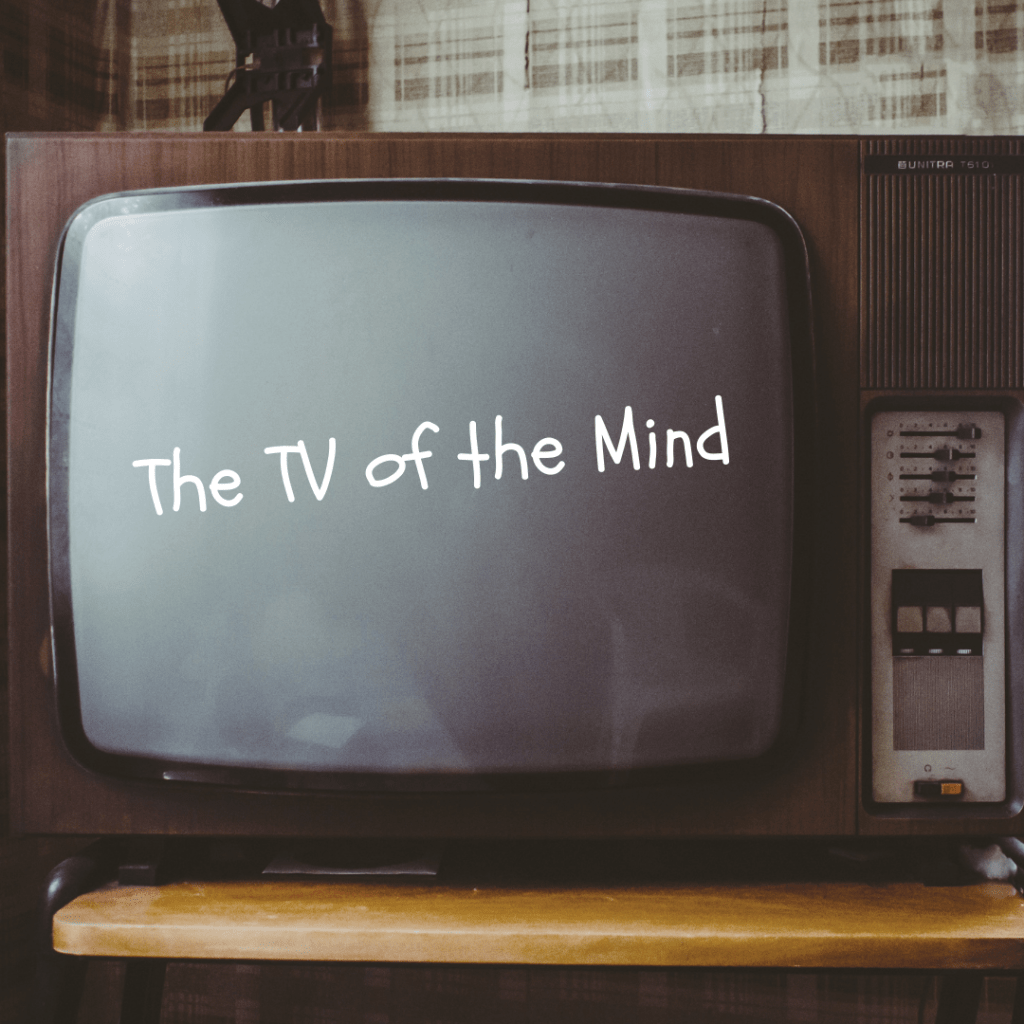
If we think of the mind as a TV, we can objectify the mind. We can watch the thoughts, but we don’t need to act on those thoughts. We can observe the facts as the peaceful woman on our plane did:

The plane is delayed.

We do not know where or when the plane will land.

We can choose to be aware of the facts of a situation—however unpleasant if not downright painful at times, without reacting to them.

In Martha Beck’s book, The Way of Integrity, the life coach writes candidly about her past struggles with anxiety. Her way out was through: through observing without judgment, through allowing without reacting:

“Clearly, my thoughts caused suffering. So, I didn’t obey them. Instead, I watched and questioned them until they dissolved.”

We possess this ability. We can choose to react or to grow still. We are not our mind, and our mind is not in control. We are the observer of the mind, the observer of life.

When we watch a dramatic movie, we can lose ourselves in the scenes and characters. We can literally forget that we are watching a movie, so drawn in we can become to the setting and actions of the story on the screen. But at any moment, we can become aware that we are merely the observer of the action on the colorful monitor.

When life feels unpleasant or downright painful, we can grow still and observe. We can watch without becoming the negativity or suffering.