The Underbelly of Nostalgia

It takes courage to look unflinchingly at our past without the rose-tinted glasses of “the good ‘ole days.”

Memories are a bit like movies: they stir emotions in us, but there’s a lot going on behind the scenes.

The reality of green screens, costumes, makeup— not to mention the panoply of human challenges that arrive when humans work together (i.e. sickness, fatigue, personality clashes, etc.), never make it into the final perfect cut.

Movie for One

Each of us enters a movie theater every day, 24/7. During sleeping hours we are unconscious of the action on the screens of our psyche. Sure, we might mention to a friend:

“I had the strangest dream about my house that started to leak and then fall apart from the top on down. What do you think that’s all about?”

Your friend might wax Freudian on you and say the house symbolizes your life or your marriage or your health. Regardless, the dream interpretation is intended to be considered by the receiver of the dream alone: YOU.

The movie that plays during our conscious hours loves to replay scenes of nostalgia: the “good ole’ days.” The days before:

  • the car accident
  • that family member died
  • puberty arrived
  • the big move
  • the surgery

The list goes on as do the scenes we replay for a dopamine hit of what we perceive as benign nostalgia.

A Fate Worse Than Death

Socrates is famous for stating the following shortly before his death:

“The unexamined life is not worth living.”

Ultimately, the Greek philosopher chose death over exile. For Socrates, to be exiled and unable to seek and examine life was a fate worse than death.

The Danger of Rose-Colored Glasses

There’s a subtle yet distinctive difference between appreciating memories of the past and altering them to fit the narrative you want to see.

Wearing rose-colored glasses in the face of something painful is like wearing beer googles when you start a relationship: it won’t end well.

The Fallout

So what’s the big deal? What’s so terrible about keeping our rose-tinted glasses on indefinitely?

“The body keeps score.” Bessel van der Kolk M.D.

Maybe you keep showing up to your family’s Thanksgiving dinners and smile while Uncle Bill gets drunker and louder as the evening meal continues. Your friendly exterior belies the stomach churning and shoulder knotting in your body.

Perhaps you find your personal movie theater replaying scenes from before you moved and left behind your family and friends. With rose-colored glasses, you find yourself saying things like:

“I miss them so much.”

or

“It’s so much better over there.”

But when you take off your rose-colored glasses, when you sit quite in that dark theater of your mind, you see a different movie playing: you miss the idea of them, of who you wanted them to be, not who they actually are.

After Death

When something dies, new life can begin. The same is true for those memories we’ve glazed with the high-fructose corn syrup of unhealthy nostalgia. 

A part of us has to die to accept the past as it was and not how we wished it would be.

 Acceptance means awareness has arrived and will affect our choices going forward.

And maybe then we can appreciate the past without the need to reach for those rose-tinted glasses. We can look back and see a life lived on our terms; embracing the reality of our experiences, so we are free to choose what to keep and what no longer serves us.

Training Bras and Shaving Legs

Hungry to grow up in youth; hungry to slow down in adulthood.

One of my earliest pre-teen memories was the recurring dialogue between me and my mother:

Me: I need a training bra.

Mom: There’s nothing to train.

Aggressive Insecurity

Oh, how I wanted a bra. After all, I was officially a two digit number (10) and any day now (it would be another four years), I was going to be blessed with Mother Nature’s Gift of Womanhood: the coveted period.

I obsessed about wearing a bra. Underneath that non-stop desire was insecurity. Desperate to be deemed “normal” by peers, hungry to fit in. I’d seen other girls in my 5th grade class, their white bra straps winking on shoulders like an unspoken Calling Card of Coolness, of Belonging.

A training bra signified a ticket to my Belonging.

I read and reread Judy Blume’s Are You There God? It’s Me, Margaret — folding the well-worn page where the tween protagonist does the ‘special’ breast-growing exercises while chanting the now famous words:

I must, I must, I must increase my bust.

If You Wear It, Boobs Will Come

My poor mother never heard the barrage of requests to get a training bra. It didn’t matter that I didn’t even know what a training bra was. I remember my unarticulated logic went something like this:

A training bra is a requirement, a prerequisite for boobs. I am doomed to walk the Earth as the only female in the world without “real breasts” if I don’t get that training bra. Why can’t my mother understand this??

In hindsight, my thought process was Field of Dreams: if I wear it, my boobs would come. 

Adolescent Blind Spots

No sooner had the sacred day arrived, the training bra in my pre-teen hands, that I started getting teased by a boy for sporting hairy legs.

Him: Why don’t you shave that?

Me: [horrified but hiding it] I don’t want to. [insert failed attempt at looking bored shrug]

I’d been so consumed with wearing that dang bra that I hadn’t even considered what was going on south of my torso!

Contemporary Boobs and Legs

It’s with a chuckle that I look back at that pre-teen girl who was yearning to develop so fast, she didn’t consider the beauty and wonder of her changing body right-then-and-there. Of course I didn’t. That’s youth, isn’t it? We are so hungry to grow up, eager to see what’s next, what’s next, we don’t appreciate the gift of the moment as its unfolding.

Now almost half a century on this Earth, I find myself grateful for my breasts and legs but not because of what other people will think. I appreciate the health of my body in general, and the gift of this existence.

Now, the bra is more a nuisance, a small harness more appreciated off than on. Hair removal is no longer something I do to please the “popular kids” but to please myself. 

Ordinary Miracles

What a gift this life is. The memories of my mom and I discussing the much-desired training bra is something I treasure. Even the boy who looked at my hairy legs with horror, while shame-inducing at the moment, was special in its own way. In hindsight, that moment was a hallmark of my continuing journey into womanhood. 

It’s the ordinary moments, the ones we often take for granted or hunger to rush through, that are often the most precious in retrospect. It’s why Memory Lane is flooded with commentary once we reach young adulthood. We cherish the past, the experiences we can merely capture with words — a scratch we just can’t quite itch.

Lessons from the Dead

The veil between this world is always one breath away.

I was enjoying lunch with two close friends when a text popped up on my phone. A colleague wrote to share a new’s article that the police had located the suspect who had killed our former student.

I hadn’t even known our former student had died.

Death Over Shoes

Our former student (14) was shot in a parking lot by a 17-year-old over a pair of shoes. Fourteen. A freshman in high school, weeks away from enjoying summer vacation. Fourteen with parents who love him. 

Fourteen no more.

Death Over Cancer

Earlier this week, my mother’s best friend passed. Cancer, silently arrived to her breasts and within a short window, spread throughout her body. Her last words to my mother:

“I know I’m not going to make it.”

She passed only a handful of days later.

No One is Immune

The sweet boy who died May 6th left us too soon. My mother’s best friend, left us too soon. Short of the 101 year old who dies peacefully in their sleep, most deaths create a powerful domino effect of pain. No one is immune from that person’s loss. And even the lucky few who cross over once they have reached that 3 digit status, even their passing is painful to those who love them.

Gift of the Dead

We all know we are going to cross over. We all know there’s an invisible expiration date in our future. We know no one’s getting out of here alive.

But there’s a gift the dead bring us: a stark reminder, a yanking away of the Denial Curtain we comfortably drape ourselves in most days. 

The dead were once no different than you or me: they had dreams, hopes, pains, fears, yearnings, hungers — you name it, if you have it, they did too at one point. The permanence of their passing is a raw reminder of our impermanence, a reminder that this ride of Life in the Earth School comes with a graduation for all.

The Dead Make Time Matter

I can still hear my mom’s best friend talking, the light in her fair eyes as she spoke, the way she always dressed like a million bucks, the way her New York accent made me feel home.

And although the teen who died wasn’t formally “my student” but a student at the school I taught, I can still recall his kindness. 

Both deaths, although worlds apart, remind me how precious and fleeting this life is. The veil between this world and the next is always one breath away.

The Dead Give a Reality Check

The sons of my mother’s best friend, now grown men in their 40’s, spoke at her funeral.

There is nothing like Death to bring a Reality Check to Life. Both spoke of their mother’s essence and actions — not the house she lived in or the car she drove, not how many friends she had on Instagram, not the size of her bank account or the quality of her wardrobe. 

What Matters Most:

Here are the highlights of what those grown sons shared at their mother’s funeral:

  • Thanksgiving was the most important holiday to her — she loved to have her family and friends together.
  • She loved ordering cupcakes for her grandchildren exactly the way they liked it — never forgetting which one loved chocolate and which one loved sprinkles.
  • She was a source of strength and encouragement to her sons, family, and friends — known for her positive outlook in life.
  • She was close with a cared greatly for her hairdresser

Death helps us remember what matters most.

Death Gives the Greatest Gift

Death gives us the greatest gift: Life. It’s through Death that we appreciate the miracle of an ordinary life. The sunsets, the smell of coffee, the feel of a rose petal between our fingers, the first kiss — the list goes on, doesn’t it?

The great mystery (Death), knowing it is coming for us, can serve to help us appreciate this very moment that much more.

The Little Death: What It is and Why You Need It

Authentic forgiveness requires a little death. The pain felt is required to heal.

Mourning. Grief. It looks different for everyone. It’s also the underbelly we don’t want to look at and feel. Much better to hide behind the minutia of daily life, running toward a future we’ll never get to in order to escape the painful ghosts of the past.

Kinks in Our Armor

The problem with running from pain: eventually, we wear out. Whether it’s hiding behind alcohol or an obsession with cleanliness, our beloved addictions can only stave us off from the inevitable negative emotions for a limited quantity of time.

Our psychological armor develops chinks over time. The more stubborn of us might be able to manifest a Botox-reminiscent smile, insisting that everything is fine, fine, fine. But the body doesn’t lie. The body keeps score, housing all the flavors of pain in our mortal coil: regret, shame, grief, blame, revenge, anger, guilt–all the negative emotions surrounding those memory ghosts simmer below the surface.

Watch for Fake Forgiveness

Fake forgiveness is the cubic zirconia of genuine forgiveness. It looks like the real thing. It may even sound like the real thing. But it won’t feel authentic.

Could you fool the ones you love with fake forgiveness? I’m sure you could.

The problem? You’re the one who’s continuing to suffer. You’re the one who, as Billy Joel famously said in his song, My Life:

“sooner or later you sleep in your own space
Either way it’s okay, you wake up with yourself”

Fake forgiveness is almost worse than admitting we aren’t able to forgive. It’s a lie we carry in the cells of our bodies, an invisible albatross weighing on our heart.

The Little Death

We can’t live this life without getting bruised and cut. But the same is true for our hearts and minds. Those painful memories we hold will continue to fester until we are willing to remove the Band-aids stuck in place.

The very thing that terrifies us and we try to avoid at all costs — pain — is often the very thing we need to experience in order to heal.

The little death is the acceptance that arrives with our pain. It is a spiritual surrender to what happened, to the choices we made that affected others and ourselves. Authentic forgiveness requires the death of what is no longer or what never was. Perhaps it is the death of hope and expectation, so new life can flood in. The little death allows us a rebirth.

If I tell you to think about anything BUT green elephants, what happens to your mind? Likely, all you are thinking about are those darn green elephants.

Why?

Our minds try so very hard to protect us. They are overthinking machines, working oh-so-very hard to help us. And, as in the case of our “Green Elephant” example, they don’t often do a very good job at this.

Pain is our brain’s Green Elephant, working overtime to protect us. But we need to embrace the pain if we want to get to the other side and experience true peace.

Brene Brown on Hurting

We live in a culture where immediate gratification reigns supreme. Lose weight–quickly. Get rich–quickly.

But while technology has greatly and rapidly improved in a short time span, the human soul timelessly needs what it needs: forgiveness, compassion, kindness, empathy. And there’s no Instagram or Twitter account that will acquire those things for us.

Peace arrives when we are willing to remove our psychological armor in a compassionate, patient light, trusting that the hurt will pass.

—–

Click here to discover a way to manifest abundance.

When to Take Your Pants Off: A Spiritual Lesson on Dealing with a Difficult Person

Got a figurative Pit Bull chomping at the bit?

Our greatest teachers are often the ones that bring the hardest lessons to learn. Their lessons require us to lean into discomfort. When we walk through them, we emerge stronger, kinder, and more resilient. I guess there’s a reason we refer to them as growing pains.

Signs of a Toxic Person

You know those humans who make you feel like you are walking on eggshells? You know, the ones who make you feel like you’re going crazy, accusing you of the very things they do? The ones who are never wrong, who lack empathy, who attempt to control everything and everyone? Those humans make Life’s greatest teachers.

Why Toxic People Make the Greatest Teachers

Contrast is what propels us forward in this thing called Life. We would not appreciate sweet without bitter nor salty without the sour. Likewise, contrast provides the conduit for our growth. The greater the contrast, the more opportunity for our growth.

When you experience control, gaslighting, manipulation, or any other form of emotional/mental toxicity, you learn about the importance of setting boundaries, speaking up, and saying no.

Why You Want to Remove Your Pants

So there I was, on the phone, with a dear friend of mine who, like me, has experienced a lifetime of toxic people. He was helping me work through one particular toxic person in my Life who has used repeated (5+ at the writing of this piece)litigation and financial power to manipulate and control. This toxic person was now threatening another litigation. Up until this point, I had fought back. It wasn’t vengefulness on my part; it was self-defense. It was using my voice — something this particular Toxic person didn’t like.

What do I do?

You fought the good fight. You stood up for what you knew was right. But when there’s a Pit Bull chomping at your leg, you gotta take off your pants.

And there it was: my greatest lesson. Sometimes, when dealing with a toxic person, the lesson is to simply let go, to accept where you are and what the Pit Bull is doing.

The Pit Bull and The Pants

So, the Pit Bull (aka, the Lover of Litigation) has my “pants” (i.e., another day in court). Here’s the gem: I am not the pants. I am free to live my life however I choose. The Pit Bull may follow through on Litigation #6, but that doesn’t stop me from living in the gift of the present moment.

We can’t control the way someone else will behave in this Life. We find peace when we surrender our figurative pants to a Pit Bull. The Pit Bull wants the “meat” of us — they want a reaction. Emotion feeds the Pit Bull; to starve them is your ticket to inner peace and happiness.

Sometimes, we need to surrender our pants in order to unearth our Zen.

Click here if you want a more vegetarian lifestyle

Parallel Lives:

Writing the Story Behind the Surface

Discover a powerful writing technique for understanding ourselves and our experiences.

Teaching English to middle school students during the peak of Covid last year often rendered me daydreaming for a lobotomy. It wasn’t the students. It was the eggshell-like-fear the teachers and students felt each day, not knowing how close to sit or converse, not knowing when to remove our masks to eat.

The inconsistent hybrid learning didn’t make teaching or learning any easier. Students’ WIFI would cause them to freeze mid-sentence, someone’s volume in the classroom would cause a deafening high pitch, or a student would choose not to show their face in our Microsoft Team’s meeting.

Staff was still expected to meet progress report and report card deadlines, attend 504 accommodation meetings, create curriculum, monitor students’ progress, discipline, nurture—you name it, teachers were meant to do it. 

English teachers are the ones who receive poetry and stories and personal essays bleeding with pain. We are most commonly the ones who notify the guidance counselor and make that call to CPS. 

Even though I’m no longer in the classroom, I am still a teacher. I’m still the person students share their creative stories with, fiction and nonfiction. It is a gift to be on the receiving end of their writing.

The teenagers I work with instinctively know that writing is a process. It helps them connect the dots in their lives, helps them to understand the world around them and their place in it.

Here’s the truth: we are all students. We are all trying to make sense of this topsy-turvy world on a macro and micro level. 

The gifted writer, Anna Quindlen, addresses this need for writing as a means of processing our very lives. We write to know ourselves, and in many ways, to heal ourselves. Writing as self-reflection is therapeutic.

Dr. Charon and Parallel Charts

Dr. Rita Charon founded a writing technique at Columbia University’s medical school called Parallel Charts. In Quindlen’s book, Write for Your Life, Quindlen quotes a summary of Dr. Charon’s Parallel Chart technique assigned to 3rd year medical students:

“If your patient dying of prostate cancer reminds you of your grandfather, who died of that disease last summer, and each time you go into the patient’s room, you weep for your grandfather, you cannot write that in the hospital chart. We will not let you. And yet it has to be written somewhere.  You write it in the Parallel Chart.”

Students and Adults Alike: The Need for Parallel Charts

Whether we are a student grappling with a tough home life, or an adult challenged by a difficult boss, we all experience stressors that can’t always be handled head on. Parallel Charts allows us to process and work through difficult emotions and situations.

Quindlen offers us an opportunity to do Parallel Charts in any circumstance:

“Take a look at your calendar, or your class schedule. Dates, numbers, times, and yet, for each, there is an observation, or a sentiment, behind it, whether of that specific event or course or of how you were feeling that day. There is a story behind our to-do lists.”

The Magic of Parallel Charts:

There’s an alchemy that occurs when we write the underbelly of our thoughts, when we connect with the surface of the day’s experiences and take time to digest them. When we write that we have a doctor’s appointment at noon, there’s the feel of the plastic chairs in your mind, the kind man behind the desk who has a picture of his daughter and wife next to a block calendar. When we write what we are experiencing behind the scenes, we boost our connection to the world around us and our place in it.

Are You Laughing in Pain?

Great comedians like Robbin Williams and Lucille Ball did it. They laughed despite their pain. Learn the difference between humor as a release and humor as a deflective strategy.


I have a dear friend from college who I refer to as The Deflection King. When things get serious, he goes for humor. It takes intelligence to throw out the quick zingers he often does. Most of the time, his comedy is welcome, but there are times when his personal stand-up routine is both sad and frustrating.

What Does Deflection Mean Anyway?

The word deflect comes from the Latin word deflectere. De means away from + flectere means to bend. Humor is my friend’s way of deflecting a barrage of whatever unpleasant experiences come his way.

I happen to love humor, and like my friend, I’ve spent time on stages performing as a stand-up comic. Humor can be a fantastic balm to a hurting spirit. Humor sugar coats some often painful medicine, allowing it a more palatable digestion.

Humor as a Band-aid

But when we use humor to deflect, it becomes a coping strategy, a comedic Band-aid that prevents us from growing and moving forward. Deflection becomes armor that might keep us from getting hurt, but it also keeps us from experiencing life fully. Over time, that armor becomes a weight, and we might wonder why we feel so alone.

Deflection is defined as causing (something) to change direction by interposing something. Verbal deflection pushes loved ones away and keeps the deflector “safe” from feeling anything of substance. Deflection is the young sibling of Denial and will literally keep us away from the chance of experiencing a genuine connection.

My dear friend has a heart of gold. He is loyal to his family and friends. He also has uncanny comedic timing and possesses the ability to make a crowd wish they were sporting Depends. But this King of Deflection is in pain and no amount of sharp jokes will remove the turmoil in his eyes.

Comedians in Pain

I think of the late and great Robbin Williams, bringing tears of laughter to millions of people through the years. I think of Christopher Titus whose mother and sister both committed suicide; I think of Lucille Ball whose offscreen personal life did not look anything like the slapstick humor the late comedic genius displayed onscreen. Humor can be wonderfully therapeutic, but we also need to be willing to look under the spiritual hood.

So, the next time you find yourself or a loved one tapping a funny bone, ask yourself: is there a bigger story here that I’m ignoring? Humor can often be the vehicle to truth.

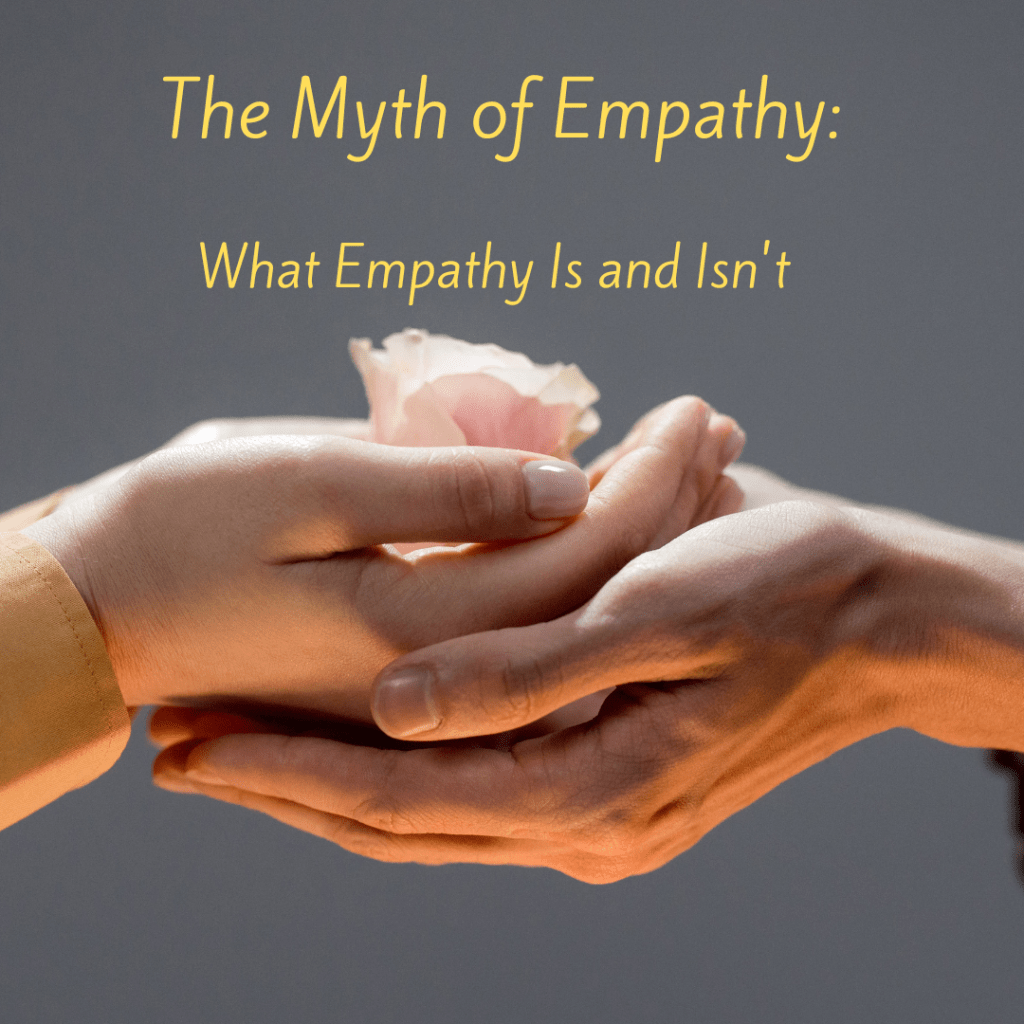
They Myth of Empathy: What It Is and Isn’t

The notion that empathy can deplete our mental resources or hurt us is an unarticulated myth.We can appreciate someone else’s suffering without the need to experience it.

A good friend has a car accident. Your uncle has dementia. A sibling has breast cancer. In each of these situations, as in any challenging time in the lives of loved ones, our heart has the opportunity to open and experience compassion.

But sometimes, we humans confuse Compassion’s powerful sibling, Empathy, for a virus that’s potentially contagious. 

So, we close up, emotionally distancing ourselves from whatever turmoil a loved one is experiencing, not because we don’t care, but because we are afraid to care too much.

Empathy Fear in Action

Years ago, a friend of mine saw I was struggling with a family issue. When I articulated what was going on, she told me the following:

“You know I love you, but I can’t be around you while you are going through this. It’s too hard for me. Once it’s over, let’s get together.”

Despite knowing me for years, my friend equated “being there for me” with somehow catching the challenges I was facing.

What Empathy is Not

Empathy is not something that requires physical, emotional, or spiritual stamina. It doesn’t ask us to drain our health, bank account, or time. Empathy doesn’t infringe or demand. It isn’t a cosmic paramecium, feeding off of us to help another.

What Empathy Is

The prefix EM means to put into or bring to a certain state. The root word PATHY means feeling or suffering. To have empathy to imagine what another feels in a given situation. We are imagining the Other’s experience, but we are not in the situation itself. Empathy is the emotional lubricant that allows humanity to connect. By putting ourselves in another’s shoes, we stimulate Compassion.

Empathy in Action

My friend’s fear of empathy ironically prevented her from experiencing it. When someone loses a loved one, when there’s a difficult divorce, when a family member is robbed — the greatest thing we can do for that person is be present. The sufferer does not expect their friend to BE in pain, only to acknowledge that it’s there.

Empathy is a silent or verbal acknowledgement to let the sufferer know they are not alone. It can manifest in anything from a homemade pie to a text, letting them know you’re thinking of them.

The Myth of Empathy

There’s this unspoken fear that demonstrating empathy, allowing ourselves to “go there” for someone in pain, is going to break us. 

But the opposite is true: when we open our hearts to someone else’s pain, our heart gets stronger, not weaker. Our ability to put ourselves in another’s figurative shoes makes us more powerful, not less.

A Surprising Benefit to Empathy

When we lean into empathy for another’s suffering, we strengthen self-compassion for ourselves. By welcoming the unwelcome in others, we grow more understanding and forgiving of our own imperfections and challenges.

What’s the Big Deal with Meditation?

Meditation is about giving the fractured parts of us a space to commune.

Last night, the rain slammed against the windows of my home and woke me up, thunder making sure I stayed awake. I tossed and turned, not quite asleep but not awake either, as the light bled into the bedroom with the dawn.

A couple of years ago, a storm like that would have easily rendered me hitting my pillow, counting, and recounting the hours of sleep I was missing. A couple of years ago, I perceived life coming at me more than coming through me. A couple of years ago, I saw my brain’s worst-case-scenario game as something belonging to me instead of a mere function of that organ warehoused in my body.

My external life hasn’t changed much in these past couple of years. There’s still bills to pay, traffic to maneuver through, personal challenges to face — you name it, life stressors continue.

So, what’s changed? What’s given me the gift of inner peace, the ability to both strive and surrender, to relish experience over destination, to trust that everything is always working out — even at those times when my brain is telling me a very different story?

Meditation. I love it and cannot recommend it enough.

The prefix medi is Latin for middle. When we meditate, we are putting ourselves into this middle space between waking and dreaming. We are both in our physical bodies and beyond them.

In the middle, we are able to watch our thoughts without judgment or censorship. Meditation allows us to go from a micro to macro perspective. The late and great, Dr. Wayne Dyer wrote powerfully about this in his book, The Shift: Taking Your Life from Ambition to Meaning:

“Becoming the observer (step back) you begin to live in process, trusting where our source is taking you. You begin to detach from the outcome. That detachment allows you to stop fighting and allows things to just come to you…You get to a place where you begin to be guided by something greater than yourself.” -Dr. Wayne Dyer

The gift of meditation grows over time. Each time I take those 10–15 minutes in the morning to meditate, my spiritual muscles are stronger than the day before. If I find myself in what I perceive to be a stressful situation, I am able to catch myself that much sooner and breathe through any unpleasant feelings that arise, “welcoming the unwelcome” (Pema Chodron), knowing as the pithy goes, “This too shall pass.”

There is no wrong way to meditate. Go for a walk, listen to the air conditioning as you sit comfortably on a chair, fold laundry, paying attention to the sensations of the fabrics your fingers touch.

Meditation is about giving the fractured parts of us a space to commune. It’s an opportunity to slow down and observe, to watch without fixing, to feel without concealing, to allow our sheer being to just…be. Over time, you learn to trust both the Universe and your inner knowing (which, in my book, are one in the same).

“People can tell you all kinds of wrong directions, lead you around any corner. You can’t trust any of that. You can’t even trust me. What do they say in car adverts? About the navigation system? Comes as standard. Everything you need to know about right and wrong is already there. It comes as standard. It’s like music. You just have to listen.” How to Stop Time (author, Matt Haig).

Meditation is the portal to listening and by extension, knowing ourselves.

What’s the big deal about meditation?

In my opinion, everything. Cultivating our inner compass is where the real magic happens.

Got Anxiety? (It’s Not You)

The heart-racing-sweaty-brow unpleasant-sensations are byproducts that aren’t you!

There’s this organ that can wreak havoc on our body and spirit — if we permit it. It’s a clever organ with the best of good intentions, like a toddler who decides to surprise their parents with a “homemade breakfast.” You know that kitchen is going to look like a disaster area when that two-year old is finished making your special meal.

So, what’s this organ that behaves like a toddler? The brain.

The brain does everything to protect you if it senses the slightest danger. Sometimes, as in the case of a fire or a robbery, it does exactly what it’s meant to do, acting quickly on our behalf — no different than that thoughtful toddler who brings home a necklace for you out of Fruit-loops’ cereal. Beautiful intention and outcome align.

But sometimes, our well-meaning brain works against us, offering up a mess of what-if scenarios we don’t need. Anxiety creeps in, all of the cortisol activity from our fight-or-flight manifesting in anything from panic attacks to irrational fears.

When anxiety takes the driver’s seat, we can’t seem to steer our way out of fear. Reason seems miles away.

What can we do when anxiety is driving our lives?

Here are three powerful tools to put YOU back into the driver’s seat and dispel anxiety:

1. Depersonalize anxiety: When your well-meaning toddler made you breakfast, they left several cracked and sticky eggshells all over the kitchen floor, syrup spilling at the edge of the counter, and caked flour stuck on the fridge door. The room is amess! But do you get mad at that toddler? Of course not.

Your well-meaning brain is only doing what it knows how to do. You can give that overworking-well-intentioned organ a heartfelt thank you and not take the mess of thoughts they create personally.

2. Objectify anxiety: We tend to see anxiety as a part of us, but it is nothing more than emotion passing through us. When the weather is stormy with skies the color of slate, we don’t say “Oh no, I must have done something terrible.” We know that the state of weather is not a reflection of us.

Our anxiety is no different from the weather. Anxiety is an emotion that is no different than any other emotion. When we see it as something separate from us, passing through us, we remember that we are whole and happen to experience this particular emotion that is not us.

3. Welcome anxiety: I know, I know, it sounds counterintuitive, but it works! When we lean into the very thing we fear, the fear dissipates. We are no longer fighting what feels like an uphill battle. Our brains want to fight something to help us; when we surrender to those unpleasant feelings, they ironically, pass through us that much faster.

As the late French philosopher, Pierre Teilhard de Chardin once said:

“We are not human beings having a spiritual experience; we are spiritual beings having a human experience.

Anxiety, like everything else in life, is moving through you. Anxiety is an experience created by our active, well-meaning brains. But we are not our brains. We are spiritual beings. When we observe without attaching, we can enjoy the ride even more.