Relationship Choosing is HARD

Jordan always opened the car door for me. He said all the right things: asking how my day was, complimenting how I looked, asking me on another date.

But he also refused to kiss me after I’d eaten shrimp.

“You want to kiss me? You’ll have to brush your teeth first. Shrimp isn’t kosher.”

His words made sense from a logical standpoint: shrimp is shellfish and Jordan eats kosher.

Yet from an intuitive, gut-level, Jordan’s words felt judgmental and controlling.

Intuition Whispers

Intuition (typically) doesn’t scream. No, intuition is that sweet friend at a party that whispers you have a poppy seed stuck between your two front teeth. 

Our intuition speaks to us through feelings.

At first, those feelings are subtle. And that’s when it’s the most important time to pay attention.

The actions of another matter more than words.

Jordan said all of the “right things, but his actions told me everything.

What is Intuition Anyway?

The root word tuit is from the latin word tueri which translates to tutor and means “to look at or watch over.”

Our intuition is us going within for counseling our guidance.

My intuition told me to heed the feeling of constraint and judgment I felt based on Jordan’s actions.

And yet, I ignored my intuition. I pushed it away and focused on the external. I choose to see only Jordan’s:

  • full head of blond hair that I loved running my fingers through
  • green eyes light up when I entered a room
  • kisses that left me swooning

Youth is no excuse, but I was very young at the time. 

There is a tendency in youth to possess an affinity for the external of things.

I brushed my teeth, shoving down the bitter taste I felt despite my minty fresh breath.

When We Ignore Intuition

Jordan started saying things that made me feel like I was in a snow globe: his words both haunting and hypnotic.

“I want to take care of you. I want to put you up on a shelf.”

When were about to meet his parents, Jordan insisted we go clothes shopping for me.

Me:“Why? I have plenty of clothing.”

Jordan: “I didn’t want to say anything, but it’s the way you dress. My parents are conservative. I don’t want them to get the wrong impression about you.”

Again, my intuition spoke to me; only this time it was more of a poking, sickening feeling. It said:

You can dress however you want to. This man does not get to decide what you wear. 

Still, I ignored my intuition’s pokes and jabs for me to “wake up” and wore “Jordan Approved Clothing” to meet his parents.

The bitter taste of shame from when I brushed my teeth to please Jordan tainted everything I ate that night.

Intuition Never Gives Up

I am not ready to share the final straw that broke me open, but I will note:

Our intuition never leaves us; it only grows louder with time.

It would be almost two decades before I finally listened to my intuition. Two decades of:

  • the waves of shame and judgement 
  • living under Jordan’s figurative thumb
  • physical ailments
  • low self-esteem

Our body develops an affinity for sickness when we depend on another for our self-worth.

Intuition speaks to us by highlighting those negative feelings and outward symptoms. It offers more and more unpleasant sensations, unrelenting until we are ready to pay attention and change course.

The Danger of Running from Loneliness

I met Jordan after losing someone very close to me.

Mourning is not a good time to start dating.

I was in terrible emotional pain over the loss of someone dear to me. I wanted something to stop the palpable sense of “aloneness” I’d felt.

When we feel lonely, it is important to acknowledge the feeling, lean into it, embrace it.

There’s a lesson in every emotion. It’s there to teach us something about ourselves.

Our intuition wants us to acknowledge the good and bad feelings that come up in life.

But I didn’t want to feel the pain. I wanted anything and everything to take me in and never let go.

Not the best time to date. It’s no wonder I attracted someone who wanted to put me on a shelf.

When we run from a negative emotion, we ironically, invite it to stay longer.

It wasn’t until I went through the pain that I began to discover peace.

Relationship Choosing is Hard

Relationship choosing is HARD! 

The prefix RE means back or again.

When we enter into a relationship, we are literally seeing a reflection about who and where we are in our life’s journey.

  • Someone is rubbing you the wrong way? There’s a lesson there.
  • Find yourself attracting controlling people? There’s a lesson there.
  • Feeling misunderstood by your partner? There’s a lesson there.

And if you are feeling lonely, there is a lesson there as well because:

The most important relationship you will ever have is the one with yourself.

When we fall in love with ourselves, discovering and embracing all of our facets, our intuition thanks us with those good-feeling vibes we are craving.

When self-love is at the helm of our spiritual ship, our internal compass steers us right where we need to be, again and again.

So, the next time you find yourself feeling something less-than-pleasant from a loved one, ask yourself:

What is this feeling showing me?

Self-compassion is the cornerstone for hearing our intuition. It offers us the sacred space to honor what we are experiencing, without judgement.

*Name has been altered for privacy.

Want to Break a Habit?

What did you love as a kid? Tapping into your past love might just be what your neural pathways need. 

Mike had always loved white whales. As a kid, he was obsessed with studying them.

Recently, he went on a trip of a lifetime, spending a week studying them up close.

“On the plane ride home, I noticed my nails had grown. The entire time I was living out my dream, high on the ecstasy of seeing the great whites, I never felt the need or desire to go to town on my nails.” Curious, Mike decided to put his fingers to his lips.

“In that moment, I knew I was at a crossroads. I could easily go back to biting my nails. The grooves were already in my brain, just waiting for me to make them deeper. But I caught myself. I made myself remember how amazing it was to be with the whales, and with little effort, my desire to bite my nails went down significantly.”

By identifying the positive emotion with the lack of desire to nail bite, Mike had fired up new neural pathways.

Creating New Grooves

We are the stories we tell ourselves. 

A habit is just a thought you continue to think.

By becoming the Objective Observer (as Mike did), we can create new neural pathways.

When we find ourselves craving a cigarette, we can grow still and resist the urge to go down that well-worn groove in our brain. We can “pull a Mike” and consider a time when we weren’t craving nicotine.

Avoidance Habits

Sometimes, we hide from something after an unpleasant experience. We can find ourselves avoiding:

  •  highways after experiencing a car accident on one
  • intimacy after experiencing a betrayal
  • flying after losing a family member to a plane crash

Again, the narrative we continue to tell ourselves determines our behavior, the neural pathways we’ve formed growing ever-stronger.

Or…

We can allow ourselves to feel discomfort and with self-compassion, choose to:

  • drive on a highway
  • go on a date
  • board a plane

The discomfort and anxiety felt after altering our behavior is our brain’s way of trying to protect us. 

Like a toddler, a change in routine is likely to cause a “temper tantrum”, the mind’s defiance against the new neural pathways.

But each time we perform the new behavior, the old neural pathways will start to fade. A new, healthier habit begins to form.

And just like Mike acknowledged, the temptation to return to old, familiar “grooves” will likely remain. Thank you free will.

The Objective Observer’s Power

Abraham Lincoln once said:

“People are just as happy as they make their minds up to be.”

When we grow still, we have the power to observe the monkey mind, observing it as an Objective Observer. We are no longer a victim of our mind’s thoughts, we are a nonjudgemental and compassionate observer.

Cravings and habits are the monkey mind’s drugs of choice.

By growing still and observing the hankering for example, nicotine, we can give ourselves self-compassion, acknowledging our discomfort as we choose a different neural pathway, a different choice.

Caveat

I am not a medical professional. I am an observer of life on this planet for almost half a century. And when my friend Mike shared his experience, I asked him if I could share his insight (He gave me the green light:-). 

How cool is it to know we can alter our brain’s chemistry by choosing different thoughts?

Every minute of every day, our bodies are physically reacting in response to the thoughts that run through our minds. Just thinking about something causes our brain to release neurotransmitters that allow it to “speak” with parts of itself and our nervous system.

Those neurotransmitters control all of our body’s functions — from hormones to digestion and our very emotions!

As the late and great Dr. Dyer said:

Change your thoughts, change your life.

We each have a veritable apothecary at our disposal. It starts with the very thoughts we think. 

When we change the way we look things, the things we look at change.-Dr. Dyer

*Name has been altered to respect person’s privacy.

My Therapist, Kenny Rogers

The late Kenny Rogers recently made an entrance into my life.

Maybe it’s because he knew I needed some help.

The singer and songwriter’s lyrics whispered to me like a forgotten dream:

“I’ve made a life out of readin’ people’s faces, knowin’ what the cards were by the way they held their eyes. So if you don’t mind my sayin’, I can see you’re out of aces.”

How’d Kenny know I was out of aces?

Kenny Roger’s Wisdom

To live means risk. Life hands us a deck of cards. Some of those cards are desirable; some are the kind you want to hide from the world.

The cards life deals us are always changing. And one person’s perception of fortune can be another’s confirmation of failure.

How we perceive life’s cards makes all the difference.

Kenny’s lyrics reminds us that our attitude affects a great deal of our outcome.

If we believe we are out of aces — opportunity or fortune, it will show in our body language.

The Problem

A family member called me a couple of times while I was at work to tell me:

“It’s your birthday soon. Here’s what you are going to do. Here’s when you are going to do it.”

It’s worth noting: I had told my family I had a big work event and not to call me that day.

This family member not only didn’t respect my reminder not to call that day; they called me twice, finally leaving a text message that their “plane tickets” were all booked and now they were waiting for me to book mine.

There was never any question such as:

  • Would a trip on this day at this place work with your schedule?
  • What would you like to do for your 50th?

My Therapist, Kenny Rogers

I was annoyed that this family member was dictating how I “should” celebrate my birthday.

There’s something about turning 50 that feels symbolic. It’s the chronological wake-up call to take stock of life, standing on the precipice of life’s past and the unknown future left.

“I don’t want them telling me what to do or how to celebrate my birthday!”

Thankfully, I had my dear therapist, Kenny Rogers to offer his gambling wisdom:

“You’ve got to know when to hold ’em, know when to fold ’em, know when to walk away, and know when to run.”

And Kenny’s sage advice continued:

“Every gambler knows, that the secret to surviving’ is knowin’ what to throw away and knowin’ what to keep.”

Mic drop, Kenny Rogers. Man does he know his stuff.

Life’s Gamble

The family member who made my blood pressure rise has a huge heart.

And here’s the truth: no one can make us angry unless we allow it.

An Australian army nurse, Elizabeth Kenny once said:

“He who angers you, controls you.”

We are all diamonds in this life, coming into this space and time with many facets. Sometimes, the less attractive facets shine brighter than others.

The facets we choose to focus on determine our life’s experience.

I could choose to focus on my family member’s controlling personality facet, or I could decide to lean into their big heart.

Our challenges are either “winners or losers”, depending on how we perceive them.

Kenny Helps Me Decide How to Play

Kenny helped me see that my family member is nothing more than a little child in a grown up’s body, so eager to see me and celebrate my birthday, they forgot things like:

  • boundaries
  • considering my perspective

There is no malice to this family member. I’ve often thought of them as bull in a china shop: opinionated, loud, and clueless to what they are psychologically knocking over in their wake.

This person puts everything into their family. And sometimes that means missing the forest for the trees.

So, I’ve decided to turn 50 in the location they’ve told — er, strongly suggested. My ticket is booked. I will get to be surrounded by family I miss like crazy.

I’ve let go of the need for this family member to be a “winning card” on my terms and accepted them for where they are right now.

I’ve let go of the need to “change my hand”, appreciating the family deck just the way it is.

For this round of life, I’ve decided to hold. And it feels pretty darn good.

*Kenny Rogers’ lyrics are from The Gambler

Starbucks Saves Lives


After 25 years working with one of the largest advertising (J. Walter Thompson) firms in the country, Michael was let go.

Twenty-five years of working in a culture that required energetic, young and aggressive employees who put work before family.

Twenty-five years of jumping where and when the company dictated you go.

Twenty-five years of reminders that the high-firm did not encourage or accept “praise memos” in case they had to fire someone.

At 55, Michael was no longer considered young. It didn’t matter that he produced and performed. He was expendable, replaceable.

So, after 25 years of loyal service and sacrifices of his time with family, he was suddenly unemployed, economically up shit’s creek.

The Starbuck’s Fairy

Michael’s life was falling apart. Despite growing up with a silver spoon, attending Yale, and landing a job with JW Thompson upon his Ivy League graduation, he was now:

  • 55 and jobless
  • needing to have brain surgery for an acoustic neuroma
  • divorced
  • without medical insurance

It was while Michael was sipping a latte in a Broadway Starbucks, wondering how his life fell into the toilet that his life began to change:

“They [Starbucks] were having what they call a hiring event. I was all dressed up with my briefcase pretending I was still a successful ad guy. A woman named Crystal walked over to me and said would you like a job? If I thought about it I would have said no, but I instantly said yes.” –Michael Gates Gill

The Success Behind Starbucks

Michael is one story of many whose lives were altered for the better through Starbucks. Their model works because it is based on respect and compassion.

Starbucks’ employees are referred to as Partners.

There is an understood mindset of we, not you or me.

Starbucks invests in its employees.

Medical, dental, and vision benefits are available to part and full time employees. There are stock opportunities as well as 100% tuition coverage available.

Starbucks cares about its community

It’s important for Partners to be happy and feel valued. When caring about others is a given, respect and self-respect grows. This sense of community extends to the customers. The result:

An unspoken understanding that we are in this life all together is fostered.

Michael’s Cup of Hope

Months into his employment with Starbucks, the former six-figure advertising exec discovers a happiness he’d never experienced in his “privileged” life:

“I could not deny the feeling of growing happiness in my heart. This new, quiet, inner happiness kept catching me unawares in the midst of a rush of serving a big line at Starbucks….No more fancy parties. I knew my parents would have wanted me to continue to join in with their view of a wonderful life in a perfect world lived at the highest reaches of the arts and society. I no longer had the energy or the will for. Thanks to…Starbucks, I no longer needed it.”

Starbucks’ theme of serving others brought Michael a palpable happiness in Starbucks never experienced in the corporate world.

Starbucks’ Opportunity to Grow

Whether it’s cleaning toilets, working the register, making the drinks, or bringing out the fresh pastries, to work at Starbucks means an opportunity to push past your comfort zone.

For Michael, this meant working the register.

But like a kind yet firm parent, there is a learning curve and with it, patience.

Terrified of giving back the wrong change, Michael tried to avoid the register at all costs.

Eventually, Michael faces his fear and discovers he can work the register. At the end of a shift, Michael tells Crystal (his manager):

“Look, I’m only three cents over!”

“Great. I knew you could do it, Mike.”

Crystal had more confidence in me than I had in myself.

Starbucks’ Lesson

People work hard when they feel:

  •  valued
  • respected
  • part of a team
  • supported
  • incentivized

Starbucks offers this to all of their employees. There is no sense of you vs. me. The ego is left at the door. 

Like a child, when an employee feels that they matter, confidence soars.

Starbucks doesn’t “cap” kindness and compassion. Breaks and time with family are encouraged. Education is encouraged. Health care and wellness are encouraged.

Starbucks Saves Lives

Michael Gates Gill engaging memoir, How Starbucks Saved My Life offers a window view into a man’s spiritual pilgrimage of what truly matters in this life. Through his journey, we meet other Starbucks’ Partners, whose lives are forever altered — for the better — by the corporate cultural game-changer that is Starbucks.

Imagine how many more lives could be changed if other corporations adapted the Starbucks mentality.

My Date with a Billionaire

Peter* is handsome and the founder of a company that takes in over a billion in sales each year. He travels all over the world in luxury, meets with former US Presidents, and is in fantastic shape.

Asked Out by a Billionaire

It’s not everyday that one gets asked out by a billionaire. Perhaps it’s more likely for one to be struck by lightening. 

In the Age of Cyberspace, I was sent a Friend Request by a very handsome man. 

In the Age of Cyberspace, I was able to learn a great deal about this stranger before deciding to accept his request.

The Facebook Down-Low 

Peter loves to travel. He has one sibling and owns multiple properties. Peter has a full head of hair and likes to spend time on the beach. He’s a father. He’s the Founder and owner of a well-known company.

I decided to accept Peter’s request.

Those First Text Messages

Peter was over-the-moon that I had accepted his Friend Request. He wrote eloquently and asked me engaging questions before asking me out to dinner.

“I’m in my ________ home now, but I’ll be flying back to ________ and would love to take you to dinner.”

Peter proceeded to suggest 5 different restaurants, each one ridiculously expensive. He then offered to pick me up or hire a car for me.

“Thank you for the offer. I’ll meet you there.”

My History with Wealthy Men

Years ago, I was with someone wealthy. However, when our relationship didn’t work out, the wealth was used as a weapon:

What Wealth Feels Like

So, it made sense that my spiritual hackles were raised by Peter — an affluent stranger who asked me out on social media.

Still, everyone is different and everyone deserves a chance.

 To discriminate against someone wealthy is no different than discriminating against someone poor.

Our date was set.

The Little Pebble in Your Shoe

You put on your socks, step into your shoes and something doesn’t feel right. You walk around and try to ignore it, but it’s there, you can just feel that something is in the way.

Sometimes it’s the little pebble in the shoe that needs to be addressed.

My little pebble: the age difference.

Upon further internet browsing, I learned that we weren’t ten years apart as originally assumed, nor fifteen years, but 17 years apart.

Does it Make a Difference?

As a social experiment, I’m purposely not sharing which direction this age difference is. For example, is Peter:

  • 17 years younger than me?
  • 17 years older than me?

Why?

 Because it doesn’t make a difference which way the age gap falls, almost 2 decades of “Age Distance” in either direction is significant.

What Does Matter

There’s nothing like preparing for a date with a billionaire to remind someone of what really matters:

Heeding your own inner voice and guidance.

Easier said than done on the cusp of a date with a billionaire. Suddenly, everyone has to give their two cents (seriously, no pun intended;-) As Clint Eastwood says in Dead Pool:

“Opinions are like assholes, everybody’s got one.”

And the unsolicited opinions arrived:

“Seventeen years isn’t so bad.”

“Just go out with him for the experience.”

“You’ll be taken care of.”

“Who cares if you have nothing in common — he’s rich!”

“Let him spoil you. You deserve to be spoiled.”

“When he’s that rich, who the hell cares about age.”

Going Inward

Advice aside, I needed to listen to what thought was important. 

At the end of the day, it’s what YOU think that matters.

When I got quiet, I could hear my voice above the cacophony of others’:

Money comes and goes. It does not make a person. Certainly, money makes life easier. But I do not want or need a man to make my life easier. I want someone in my age range to enjoy and experience this life with on equal footing. The uneasiness in my stomach felt every time I think of this date is my body’s intuition. 

This man seems kind. I do not want to waste his time. He deserves to spend time with someone who will look forward to his company, not one who is looking for the EXIT sign as soon as they meet.

While our financial bank accounts might look a world different, we each carry a mortal bank account and deserve to spend it wisely before our unknown expiration dates.

My Decision

Once I realized that it was better — for me — to cancel our date, I took action.

Peter was a perfect gentleman, writing that he understood and wishing me and my family a Happy Thanksgiving.

My decision to cancel the date wasn’t personal to Peter; it was personal for me.

Peter “got” that. No doubt, he will meet the perfect woman for him.

The Fallout 

As with any decision we make in this world, there are reactions from those well-meaning people in our lives with their buttholes — er, opinions.

When people are disappointed in your decision, remember that it’s about them, not you.

Peter wasn’t offended in the least. He knew my decision was not about him. The age difference was my issue, not his.

My dear family and friends (not all) were overflowing with their opinions regarding my decision. I felt like I was a sport’s team, and they hadn’t liked my last play.

At the end of the day, our life’s choices are ours to live with.

Had I gone on the date or had I maintained my decision to decline doesn’t matter to anyone else — it doesn’t affect anyone else.

People who are close to us often mistake their opinions as ours.

When we are close to someone, we can easily lose ourselves in the story told to us.

But we are not someone else’s story. We can choose, at any time, to get back into the driver’s seat of our life and decide what does and doesn’t work for us.

The Good and Bad of Opinions

Opinions offer opportunities for us to consider other viewpoints and challenge our own. 

The danger of opinions, if we aren’t vigilant, is that they can stealthily morph into our own until we are living the life someone else wanted for us.

Vigilance is key. Paying attention to our body’s reactions to another’s advice. Questioning our reactions yet trusting them to guide us.

There is no wrong decision when it comes from our intuition.

*Name is altered for privacy purposes

Thankful of Steroids

And why it matters

Want to know a secret?

Whether you think life is awful or wonderful, you are correct.

The good news: we each have the power to alter our perceptions at any moment.

Live Like My Little Sis

I’ve just returned from the gift of spending time with my younger sister in NY. Well…my sister and her family. During my time there, the following occurred:

  • the bathroom mirror literally started to peel off the wall like a Reflective Tower of Pisa
  • a washing machine began to “chew” clothing reminiscent of a toddler with teething issues
  • the brisket splattered EVERYWHERE (leaving a sticky-savory trail from the oven to the floor — the dogs were smitten)
  • children needed to be taken to doctors while work emergencies erupted

And yet, my little sis’ remained calm and easy, all while preparing a thirteen person dinner party to welcome me home.

Humor as Medicine

Listen, I’m sharing a “sample platter” of all the “dishes” my awesome sis’ handled in the days I spent at her home. This chica has A LOT going on. 

Were there conflicts that arose? Absolutely.

But Little Sis’ handled whatever came her way with humor and grace.

Humor is an undervalued form of medicine. 

Humor makes life’s challenging arrows more palatable. 

When we are able to find humor in those tense moments, we alter our perspective. Life’s challenges and heartaches don’t seem as sharp.

Humor softens our focus, working as a balm to our pain or unease.

We Become What We Think

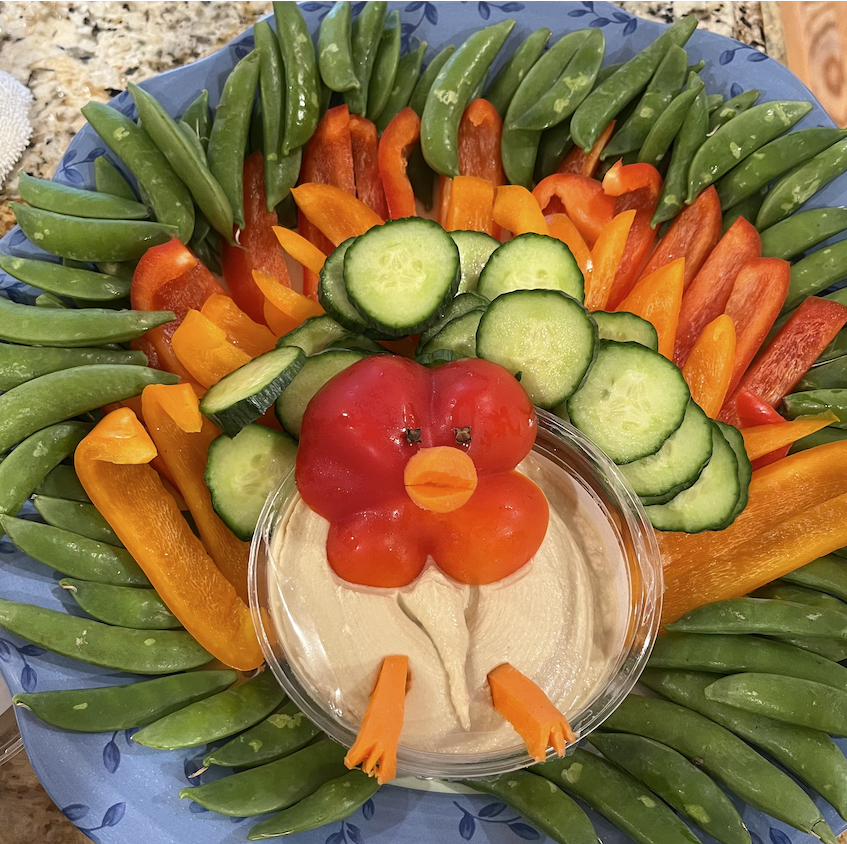
After creating the first and second platters, my sister had the same reaction each time:

“This is so much fun! Look at how cool this is? I love this!” 

My Little Sis’ was literally jumping up and down each time she completed the platters.

Her eyes danced with delight each time she completed another step creating her cornbread, her lemon zest ricotta cake, her rosemary and apple-infused turkey — you name the dish, she was lit up more than a tree at Rockefeller Center.

When challenges arose, she de-escalated the issue immediately by:

  • focusing on what was working
  • offering a helpful suggestion 
  • bringing her infectious humor

Little Sis’ loves serving the people she cares about. She loves making a difference, loves challenging herself to create new things.

Take it from Oprah:

“What you focus on expands and when you focus on the goodness in your life, you create more of it.”

Focusing on the Good is Contagious

We are all energy. So it’s no wonder that my Little Sis’ family “caught” her warmth and love throughout my visit. And, of course, I wasn’t immune either.

Appreciation is a form of meditation.

I started to notice how long my nephew’s eyelashes are when he looked down to focus on the board game we were playing.

I noticed the sound of my older nephew’s laugh made me think of a warm sunrise.

I noticed the comfort and easiness, the vulnerability and strength between my Little Sis’ and her sweet hubby.

The Gift of Slowing Down

As we approach this holiday season, I’m making a concerted effort to focus on slowing down, not speeding up. I want to relish the gift of this life, honoring my reactions and impressions along the way. 

We will never get “there” because there is no final destination.

There is only the precious moment of now. And when we choose to focus on how amazing this moment, and the next moment is, our lives grow evermore awesome.

MENTAL HEALTH

The Doctor Will See You Now

Finding insight and healing in writing

We can attend to our inner wounds through self-reflective writing.

The boy sat staring at the blank page in front him, while his fourth grade peers wrote with gusto.

One word came to mind as I took in the 9-year-old with gripped pencil in hand:

fear

Writing as a Vehicle

The students were filling in their journals, writing about their family members. Kids were smiling as they wrote about their parents, siblings, and cousins. The giddiness in the room was palpable.

Writing about ourselves is a powerful vehicle for self-discovery.

Still, the 9-year-old-boy with the gripped pencil remained staring at the untouched page.

Me: You okay?

Student: I don’t know if my dad is a family member. My mom said, I can’t see my dad anymore and that he’s no longer my dad. So, do I include my dad?

Ouch. 

Sometimes, the vehicle of writing brings some rough terrain.

Fostering Self-Discovery

Education is all about offering tools to empower. Writing is one of those foundational tools. Our world is literally built on words; it is the machinery that drives innovation and self-awareness.

The young student’s question offered an opportunity for him to self-reflect and find the answer within.

Me: That depends. What do you think? Do you think your father is still your father?

Student: Yes.

Me: Then that’s your answer.

Writing LightBulb Moments

Immediately I saw the boy’s eyes light up, his pencil no longer gripped with fear, but instead, moving with great energy in the no-longer empty journal.

When we lean into the painful questions through writing, sans judgement, aha moments abound.

Writing puts us in the driver’s seat of our life. It offers an opportunity for us to slow down and consider what we think, not what the cacophonous world at large says to think.

When we go within to write, we literally slow down our brain waves and decrease anxiety. Slowed down, we find space to explore problems from a greater creative perspective.

Writing as Therapy

The 9-year-old student was eager to share his family tree and some of their personality traits with the rest of the group. The once anxious face he carried was now emanating pure joy.

Writing offers us the opportunity to go within for counsel.

I never told the young student what to think of his father. The power to perceive his father as his father is his choice. 

Writing allows us to take the reins of our perception.

It doesn’t matter whether we are 9 or 99 years old — our perceptions are ours alone. 

Metacognition, the act of understanding one’s own thoughts and perceptions, only grows stronger with self-reflective writing.

 When we write, we are no different than a radio dial, tuning into what we think about the world around us.

Writing as a Doctor

When we write reflectively, we are taking care of ourselves. We are nurturing our brain waves and self-esteem.

When we take the time to write reflectively, we are subconsciously sending a message to our psyche: what I think and how I feel matters.

Writing reflectively opens the door to the best doctor for you to visit with: your Highest Self. Stress hormones lower, sadness is articulated and addressed. Emotions — in all of their colors — are addressed. Self-compassion and self-awareness are cultivated.

I Just Overdosed

On too much well-meaning advice

Ah, friends and family. Those well-meaning people in our lives who offer advice like candy on Halloween.

The problem?

 Taking in others’ advice is like sampling from an apothecary.

Opinions and Asses: Everyone’s Got One

Whether it’s when to leave a career or how to best file income taxes, opinions abound. We are not talking about those rare issues that offer very little gray area.

Nope. We are talking about those hem and haw mental challenges where we just aren’t certain what to do. Situations like:

  • whether to take a Gap Year after high school or head straight to university
  • plan a huge wedding or get married on the beach with only your immediate family and friends
  • have another child
  • change careers midlife

The Stealthy Side Effects of Advice

My issue was dealing with someone who was regularly hell-bent on making my life miserable. 

When we are in a painful or anxious place, we are more vulnerable to other’s well-meaning advice.

Everyone who cared about me offered up their opinions:

“Fight them in court.”

“Whatever you do, don’t go through the legal system. Only the lawyers win in court.”

“Ignore ‘em.”

“You need to see a therapist.”

“You don’t need a therapist. You need to go for a massage.”

“You need to keep busy and not think about it.”

The side effect of all of this mental and contradictory advice: my heart and head felt incapable of processing.

Here’s the danger of heeding others’ advice: the more you listen to others’ mental medicine, the less you can hear your own inner wisdom.

Word Drugs

It’s one thing to hear what another person has to say; it’s quite another to take in that advice.

Some of us are sensitive and not aligned (at the time — this too can always change) with our inner compass, so that even hearing the advice isn’t healthy for us.

When I’m not feeling centered, all I have to do is read the side effect warnings of a drug and the placebo effects begins.

But when we heed the opinions and suggestions of others, we are reneging our intuition to someone else. 

Accepting the opinions of others as your own is a form of mental ingestion. Digest enough of those varied words as yours and you’ve just mentally overdosed.

The Best Prescription

The best prescription when you feel uncertain about your next move is the one that arrives from within.

I’m not suggesting to stick your head in the sand like an ostrich (besides, that would be me giving you advice;-).

The best prescription is tuning into you. 

Maybe that means going for a walk or baking or meditating. Maybe it means drawing or taking a siesta for a couple of hours.

When we tune inwards for guidance, we find balance; we are better equipped to then hear the opinions of others without ingesting them.

Snowflake Humans

Humans are like snowflakes. Each of us is unique. And just like a snowflake, each of us is going to offer a perspective that is a one-of-a-kind-by-product from the alchemy of our environment and genetics:

Because a snowflake’s shape evolves as it journeys through the air, no two will ever be the same. Even two flakes floating side by side will each be blown through different levels of humidity and vapor to create a shape that is truly unique.-BBC

So, centered, it doesn’t surprise me that my friend who was, at one point, a victim of an abuser, gave me the advice to “Fight ’em in court.”

A family member who thankfully cannot relate to my situation but is perpetually burning the midnight oil, suggested I just “get a massage” and “don’t think about it.”

Everyone’s advice came from a loving place. But the verbal drugs they were offering were created in the lab of their own perspective.

Overdosing on others’ advice made me both fatigued and anxious. Without realizing it, “swallowing” their advice pills, I lost my way.

It wasn’t until I got quiet (lots of walks and naps:) that I realized what I needed to do — for me.

Signs of a Potential Overdose

Wondering what a potential Advice Overdose looks like? Here are some that I encountered:

  • anxiety
  • difficulty sleeping
  • irritability
  • difficulty concentrating
  • mental fatigue
  • upset stomach

Take Two and Call Me in the Morning

Joking — don’t take two of anything from me. (I’m not a doctor, though I play one on TV;-)

Be kind to yourself. Journal. Reflect. Take deep breaths. Do whatever you can to slow down and honor that voice always residing within you.

Our feelings offer a powerful guide in this life. When we slow down, we are more likely to pay attention and notice what feelings are coming up. Acknowledging them is the first step in finding the best self-prescription.

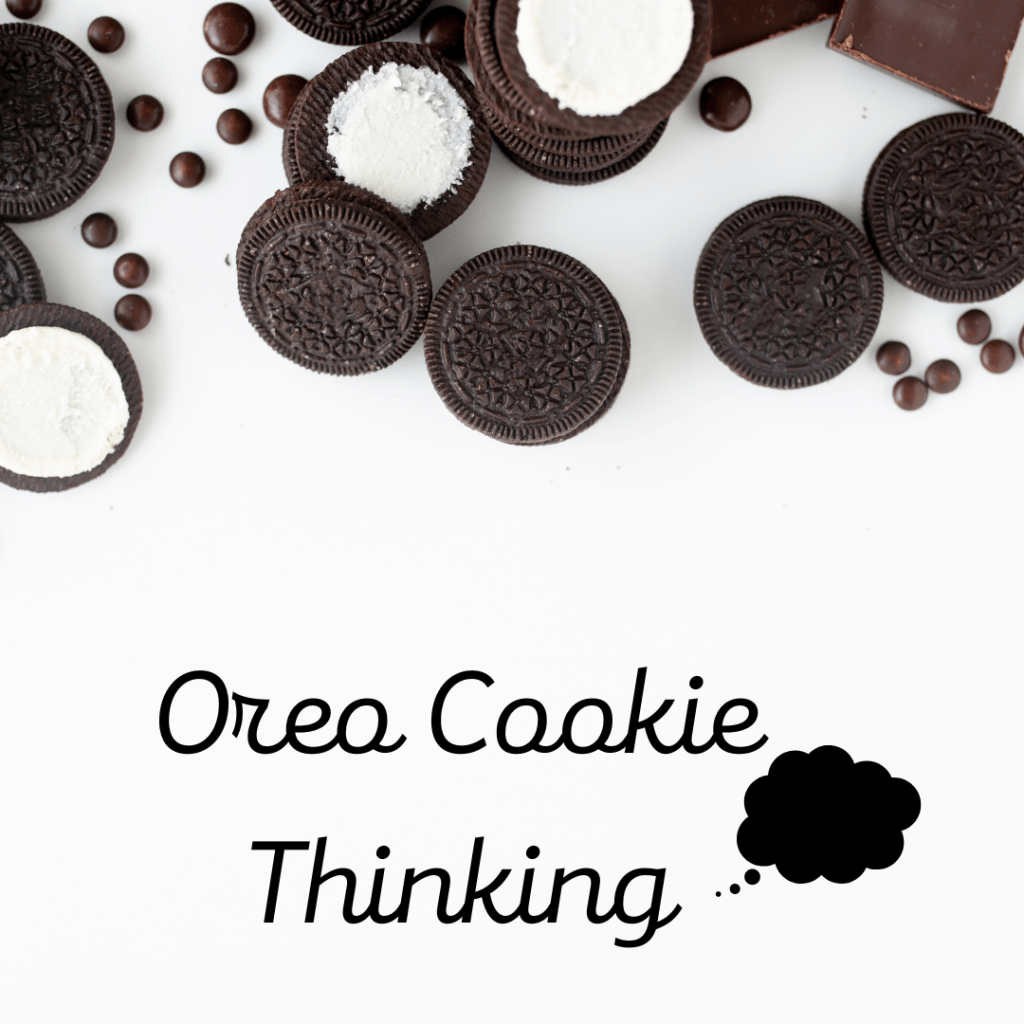
Oreo Cookie Thinking

The anxiety-driven thought process that isn’t good for anyone.

Oreo Cookie Thinking only feeds anxiety.

The homework assignment was easy enough: multiply each number by two.

My niece: I got this, Mom! I don’t need your help.

So, my sister left her daughter to work solo.

When the Problem Isn’t the Problem

My niece had completed the assignment correctly, multiplying each number as directed. But she had also added up each number — something that wasn’t part of the assignment.

When my sister pointed this out, all hell broke loose.

Forget it! I’m bad at math. I hate math. 

The problem wasn’t the math itself or my niece’s ability to do math. The real issue: all or nothing thinking.

It didn’t matter that:

  • my sister had pointed out what a great job her daughter did on the math homework.
  • my niece had, in fact, gotten all of the multiplication correct 

All my niece “heard” was the all-or-nothing inner dialogue waging war on her self-esteem:

  • I’m horrible at math.
  • I hate math.
  • The issue must be me, but instead of acknowledging this, I will hide behind hating math itself.

Oreo Cookies Are Only Good for Eating

Black or white thinking is a form of cognitive distortion that we all have to some extent. Believing that things are all good or bad, right or wrong. 

If we think of black-or-white thinking as an Oreo cookie, it helps us catch ourselves when we fall into the mental quicksand of dualistic thinking.

Oreo cookies are delicious to eat, but we don’t want to dwell in a black-or-white mindset.

When we keep Oreos in our kitchen pantries and not in our minds, we offer ourselves, and the world around us, greater compassion. 

The Skittles Life

Taste the rainbow of wonderful possibility with Skittles Thinking.

You know those high-fructose corn syrup rainbow candies? Now that’s the mental candy lifestyle that fosters a more flexible mindset.

Accepting our inner and outer world as colorful, ever changing, and perfectly imperfect allows us to grow more empathic to ourselves and others.

Life starts to look a lot more forgiving and wonderful when we see through the lens of kindness.

Oreo Thinking vs. Skittles Thinking

Oreo Thinking sounds like this:

  • I didn’t get chosen for the play because I have no talent.
  • He didn’t call because I’m unloveable.
  • I failed the test because I’m stupid.

Skittles Thinking sounds like this:

  • While it’s disappointing I didn’t get into the play, I look forward to joining the crew.
  • I miss talking to him; I’ll send him a text to say hello.
  • I know the material but allowed my nerves to get the best of me. I’ll speak to the teacher and ask if there’s a way for me to demonstrate my understanding of the material.

Fun with Food

Cognitive distortion sounds so serious, so off-putting to kids (and adults). The analogy of food makes cultivating awareness of cognitive errors much more palatable (and downright fun:-)

So, the next time you find yourself growing anxious about something, ask yourself:

Am I entering into Oreo Cooking Thinking?

Chances are, if you are feeling stressed or upset about something, there’s a strong likelihood you’ve entered into the all-or-nothing quicksand.

No worries — it’s never too late to put down that mental Oreo. 

And the great news: if you are flying high and in an easy-peasy mood, it’s likely you’ve picked up a mental bag of Skittles.

The choice is always in our cognitive hands.

The Day She Snapped

And what we can do to prevent further meltdowns

Sometimes, it’s the kindest people who experience the harshest meltdowns.

A dear friend of mine is the mother of a teen obsessed with musical theater. For the past decade, despite working full time and having one other kid to raise, her son has participated in community theater that requires my friend to drive far and wide all over New York, often late at night. 

A Window View

The other day, I was on the phone with my friend when her son came into the car from another rehearsal. Here’s how the dialogue went:

Teen: I’m hungry. 

Friend: (handing him string cheese) Here you go.

Teen: No, I want McDonald’s.

Friend: You can get that tomorrow after your PSAT test.

Teen: What the f$%&! No, I’m not taking that. I don’t even need it. I have plans with my girlfriend tomorrow.

Let’s just say, I got off that phone as quickly as possible.

The Backstory

My friend is a single mom. Everything has been on her. As her son was growing, there were several small occasions when her son spoke down to her and my friend placated or ignored the disrespectful behavior.

My friend’s empathy for her son eclipsed her judgement.

For years, my friend would say:

“He doesn’t have a father. I feel so bad for him. I want him to know how loved he is and how much he matters.”

Creating a Monster

Just prior to her son entering the car, my friend confided:

“I snapped the other day. I couldn’t take it anymore. I’ve created a monster.”

All those years of yes-ing her son in an effort to make him feel like he mattered, prevented him from learning respect and appreciating another person’s perspective — in this case, his own mother.

The Snap

We humans tend to snap when there’s been a buildup of tension and frustration. We snap after a long time of undisclosed and/or unaddressed unhappiness or resentment.

Like a zit that’s just come to a head, the snap is a manifestation of pent up emotion that needs to come out.

My friend snapped after her son told her he was going to be changing high schools because it had a better musical theater program. 

There was no discussion; in his 15-year-old-mind, changing high schools was going to happen.

Friend: I will look into the high school program.

Teen: I already know I want to do it. There’s nothing to look into. This is my life, not yours.

On and on this dialogue went until my friend, inevitably snapped:

“You know what? You are a child, a minor. Do you not understand that? You know what, just forget it. You’re going to do what you want anyway. Just do it; just do it! GO — what are you waiting for?! I don’t care anymore. Just do whatever the hell you want.”

And the teen’s response:

“It’s okay. I don’t have to do it.”

The Aftermath of a Snap

My friend felt such guilt for snapping at her son.

“You should have seen the look on his face. He looked so scared of me. I feel awful about it.”

And yet, a day later, her son was cursing up a storm in front of her, sometimes at her. There was no:

  • Thank you for picking me up from theater rehersals.

or

  • Thank you for bringing me a snack.

The Thing About Snaps

Snaps don’t address the core issue (in this case: lacking respect for a parent).

Snaps are nothing more than the surface of an emotional iceberg. 

It’s no wonder her teen returned to dictating what would and wouldn’t happen regarding the PSAT and McDonald’s. The roles in their relationship were never addressed in my friend’s snapping.

Love isn’t a Doormat

Whether married or raising kids solo, parenting is not easy. But loving our kids does not mean letting them run the show. 

We wouldn’t give a kindergartner the key to our car. Yet when we placate our children with blind consent, contorting ourselves to please them, we are effectively putting them in the driver’s seat.

There’s Still Time

I don’t know what transpired between my friend and her son after I hung up the other day. I can only hope she:

  • didn’t get him McDonald’s
  • insisted he take the PSAT
  • is going to look into the new high school and not blindly consent

As long as her son is under her roof and a minor, there’s still time for the roles to alter.

Of course, its’ easy for me to see what’s happening: I’m not in the situation. I’m a mere observer. But I can relate to those moments when a need to demonstrate love to my children eclipsed my better judgement. 

Self-compassion

My friend is trying her best. We are all just trying our best in this life. The word compassion means: to suffer with and take action. 

Self-compassion is looking within, exploring the why behind our respective snaps and doing something about it. Sometimes that means saying no to your kid, even if that no will illicit a temper tantrum.

Better a temper tantrum from our kid now than a giant snap from us later.