The Momentum of Stress

What can we do when the negative momentum we’ve talked ourselves into feels like a train we’re doomed to ride forever?

*Lia is a 6th grader who takes her academics seriously. She will turn in her work for assignments days before they are due, sending emails to her teachers to confirm that she did what was asked of her correctly. Lia has yet to earn less than an A in all her classes. She is personable, astute, and kind.

Unfortunately, there’s an invisible but real force taking over Lia’s life: anxiety. She has trouble sleeping, finds herself breaking down in tears over things that before wouldn’t have bothered her, and describes herself as unable to “stop the worrying” that haunts her throughout the day.

 Lia is not alone. Several of the middle school students I have the gift of working with are manifesting signs of anxiety and depression in the almost ubiquitous cloak we know too well: stress. And while there’s good and bad stress, our perception of those stressors makes a world of difference.

Lia met with me last week after class and talked about her inability to “stop the worrying.” 

Lia referred to herself as someone who “struggles with anxiety.” Her self-diagnosis alone powerfully affects her perceptions. So, the world around her offers up opportunities to worry, thus creating more domino-like effect, stress-inducing scenarios for her. Lia’s belief in her self-diagnosis has created a momentum of anxiety that feeds on itself like a rat snake.

The same domino effect of negative self-talk can manifest in depression. When we are regularly telling ourselves it’s hopeless, things never work out for me, or a slew of other fatalistic misconceptions, the Universe mirrors back to us “proof” that our belief was correct.

So, what can we do when the negative momentum we’ve talked ourselves into feels like a train we’re doomed to ride forever?

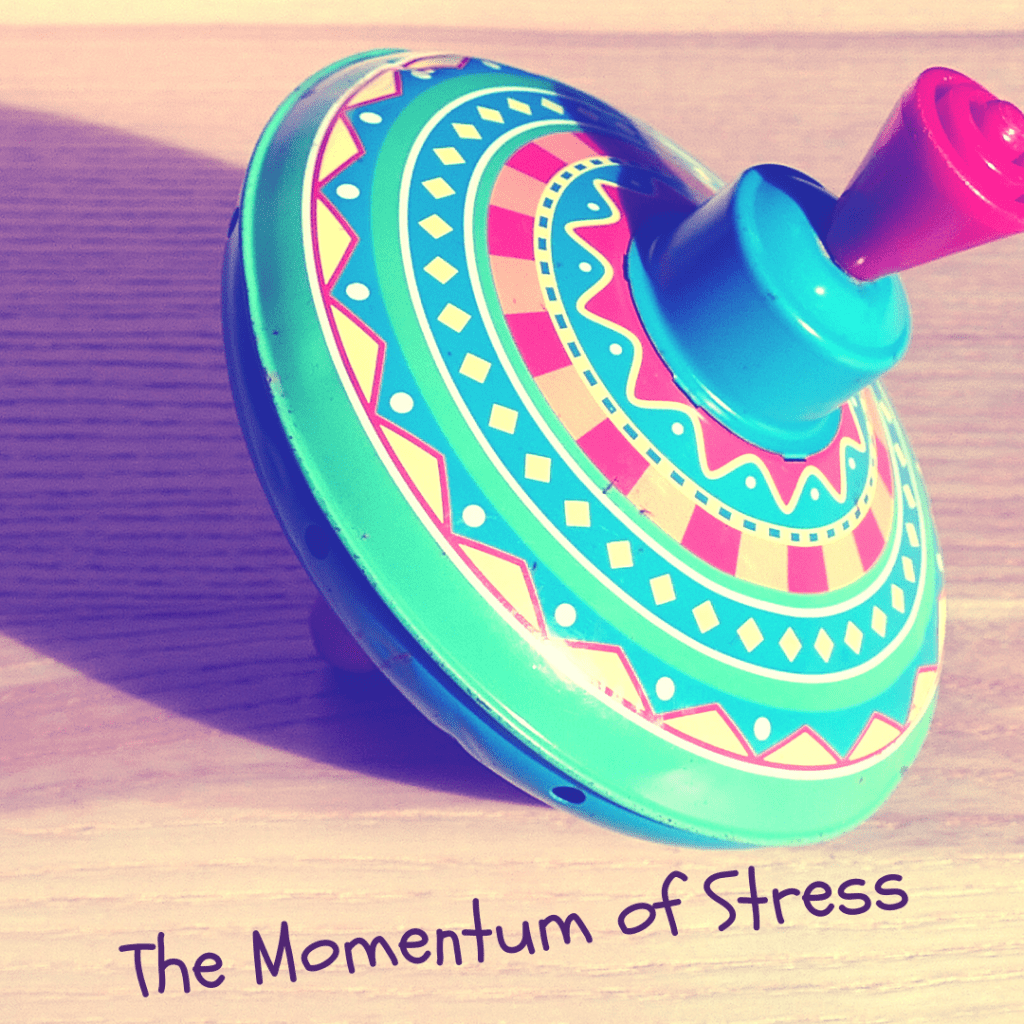
Think of a spinning top. What happens when gravity starts to take over? It finally teeters to a stop. When anxiety or depression hit a high point, know that it too will pass. You cannot remain in the high anxiety or low depression forever.

Typically, we wake up with a fresh start, a new day for a new momentum. Baby steps.

Lia asked, “How do I stop my thoughts?”

“Get out ahead of them, before the momentum starts on that train to worry. Do one thing that pleases you today. Write three things you are grateful for each morning you wake up and each night before you go to bed. Listen to music you like.”

Whether a teenager or a grownup, we all experience stress. Yet while stress is unavoidable, building momentum in the direction of peace is in our control. Stress is a continuum, and our self-talk determines whether we take a harrowing ride on an uncontrollable track or experience an adventurous journey.

Lia has altered her label since we spoke last week. She is no longer someone who “struggles with anxiety” but now refers to herself as “conscientious and capable.” And that altered shift in her perception is the foundation for a rewarding momentum.

*Name has been changed to protect the privacy of the person.

Adolescent Depression and the One-Inch Picture Frame

Like adults, sometimes tweens and teens need to reframe their perceptions..

            *Kira is a twelve-year-old with a penchant for animae and Greek mythology. She is articulate and kind, responsible and perceptive. Unfortunately, she also considers herself a disappointment to her parents and feels like she is failing her friends and family.

            *Mandy is just shy of thirteen. He attends school virtually, participating in class daily, turning in assignments on time, and deftly plays chess. Yet he has attempted suicide twice this past year. “My parents were pretty angry when they found out—my Dad especially. I think he’s upset that he didn’t know how bad it was.”

            As a middle school English teacher, I have the pleasure and responsibility of working with Kira and Mandy. After over a decade in the classroom, I’ve witnessed an unprecedented and palpable uptick in depression in tweens and teens this past academic year. No doubt, the psychological toll of pandemic life has left its mark on humankind’s psyche. The economic duress alone created waves of stress in families. Regardless of the reasons for the increased depression, unlike adults, our adolescent population may not have the tools to seek or get the help needed. 

            I teach six separate classes, and there are 1-2 students in each class struggling with depression or anxiety tainted with thoughts of hopelessness. A numbness will often emanate from them as well. As one student recently shared with me, “Nothing matters anymore. I just stopped feeling.”

            There’s a writing exercise the talented Anne Lamott shared in her famous book, Bird by Bird that I share with my students who honor me with their honesty, with the raw, underbelly of their emotions:

            “All I have to do is write down as much as I can see through a one-inch picture frame. This is all I have to bite off for the time being.”

            Now, I am not asking my students to start writing their feelings or anything at all for that matter. I am asking them to consider the idea that they are in one picture frame of their life right now—that’s just it, one frame. And while that frame might look overwhelming or render them numb or any other negative emotion for that matter, it is simply one frame. The frame, however unbearable to them, WILL pass.

            Besides, I remind them, there must be other frames that they like in their present life. Here are some recent ones they shared:

            “When my dog licks my face.”

            “Drawing—I’m working on a book!”

            “Soccer—kicking the ball.”

            “The smell of my dad’s pancakes.”

            It need be noted that the above frames were spoken with smiles that could light up a room.

            Whatever we focus on we get more of. We always have the choice to focus on a frame that makes us feel worse or better.

            I am not a doctor or therapist, nor do I play one on TV.  I am a teacher and mother who lost someone dear to suicide when I wasn’t much older than the students who are courageous enough to share their often-concealed pain with me. Perhaps they can sense the experience in me; the unspoken guidance I’m able to give that will nurture us both.

            Regardless, these students’ parents were informed; help is on the way. Help is always on the way. 

*Names have been changed to protect privacy

Small Talk: Benefit or Risk?

Knowing who you are engaging in small talk with can sometimes make all the difference…

            I recently went for my second vaccine shot. The verbal warnings from well-meaning others streamed through my head like a bad TV montage:

            “Take off from work the next day—you’ll need it.”

            “It felt like an invisible weight was pulling me down.”

            “It’ll hit you about 12 hours later. You’ll see.”

            “I wanted to die.”

            So, it’s no surprise that I approached the nurse (*Jenny) a little nervous.

 My anxiety typically manifests in a desperate need for small talk. There is this comfort, however fleeting, found in small talk for me. And according to a 2018 study by psychologist Mathias Mehl, my instinct to schmooze is understandable: 

“Small talk…is associated with more happiness than one usually experiences when one is alone.”

            I certainly didn’t want to be alone with my mental montage of dire physical warnings. I needed to focus on the sunny room of the vaccination site and the warm smile of Nurse Jenny.

            Too late—I already saw the almost comically long syringe. Too late, I asked Jenny how she was, inquiring about her children as well (a small detail I recalled from our earlier dialogue the few weeks prior) as I turned my head away.

            Too late—Jenny let out a big sigh—a hot air balloon puncturing and plummeting fast:

            “My husband is an awful man—just awful. He’s been cheating on me and now he’s suing me in our divorce. I just can’t—”

            Too late—Jenny’s emotional turmoil was let out on my arm.

  I saw stars.

            “Why does that hurt so much?” I asked.

            “Oh, you poor thing—I’m so sorry. You’re bleeding. I hit a vein.”

            Once the blood was cleaned up, Jenny wrote her name and number on a neon Post It.

            “Call me. We need to get together—go for dinner.”

            Somehow, a Small Talk Attempt to ease my anxiety had caused Jenny to think we were…Friends? Therapist (me) and patient (her)?

            Mathias Mehl’s findings regarding our tendency to find happiness through small talk may be true, but if that small talk signals another to lay down on the metaphorical Freudian couch, perhaps we need to refrain from trivial banter with people holding sharp objects…

 Source: https://www.psychologytoday.com/us/blog/out-the-ooze/202001/why-small-talk-is-big-deal

Trigger Happy

Our triggers just might be a hidden gift waiting for us to discover…

We all know the term “triggered” at this point. A good decade ago, the word may have referred to a psychological meaning related to PTSD or some other mental disorder. Yet today, you don’t need letters after your name to be familiar with the slang of someone who gets “triggered.”

According to Urban Dictionary, “triggered” refers to “when someone gets offended or gets their feelings hurt, often used in memes to describe feminist, or people with strong victimization.”

Regardless of whether one is experiencing an emotional reaction based on a genuine trauma or mild offense, the reaction is real: the blood boiling, the heart racing, the urge to scream, cry or express negative sentiment. The individual experiencing the “trigger” is in emotional pain.

But what if we could look at the cause of one’s trigger as an opportunity to grow? What if identifying and acknowledging our triggers could be the first step towards changing? What if we considered our triggers as gifts to open and observe rather than Jack-in-the-boxes to avoid at all costs?

Consider Terry Wright, the sixty-five-year-old woman charged with resisting arrest after refusing to wear a mask at a Bank of America in Texas last month. Wright is certainly entitled to an opinion on the mask issue; she is not, however, legally permitted to go mask-less into a private institution (i.e., Bank of America) that requires a mask for all visitors.

For whatever reason, following Bank of America’s mask policy to wear a mask for a mere visit triggered Wright. It triggered Wright enough that she perceived herself as a victim: 

“Hold up! Hold up! Some old lady [Wright] is getting arrested here!”

Wright’s trigger created more misperceptions:

This is police brutality.” The video cam shows no police brutality and audibly offers several bank witnesses flat out disagreeing with Wright.

Yet there was one form of brutality: Wright’s cruelty to others and herself. Her inability to reflect on her actions and continue to see herself as a victim instead of an agitator is the true crime. 

The irony: Wright stated on a phone interview, post her childish scene at the bank (and Office Depot shortly after):

“My civil rights were violated.”

One of the first definitions of civil is “cultured and polite, as in someone who is civilized.” Wright’s behavior was the antithesis of what it means to be civil, to think about others within the community and our interconnection to each other. Wright was too steeped in pain, lashing out at others instead of reflecting inward.

The next time we feel triggered, consider an alternate choice; consider the opportunity for growth. Ask yourself:

What is the lesson here for me?

What does my potential reaction say about me?

Is there another way to perceive this situation?

Is there another way to react in this moment?

When we consider a potential trigger to be a blessing instead of a curse, our perception changes and so does our reality.

*Sources: KPRC 2, Vocabulary.com, Urban Dictionary

The Parent Trust

Some new insight on raising resilient kids…

We all know helicopter parenting is a “no-no.” The idea of micromanaging our children enables an unhealthy tendency for our one day grown kids to depend on their parents or other adults to solve their problems. No doubt, helicopter parenting is a behavioral pattern that fosters co-dependency at best, inhibiting self-reliance and a strong sense of autonomy needed to thrive in this world.

            Yet there’s a more subtle, more insidious variety of helicopter parenting that many of us (myself included) are demonstrating with our kids that needs to, at the very least, be curbed: imposing our thoughts on a subject without giving our children a chance to consider, form and articulate their own thoughts.

            So how do we curb those thoughts and opinions we have? We bite our figurative and literal tongues. We listen. We listen more without reacting. We ask questions and listen some more. We wait. We trust.

            A dear friend of mine who has spent a lifetime mentoring kids recently explained the beauty of the biting-one’s-tongue process: “When you ask questions that make a child think and listen, really listen, you are setting the foundation for true cognitive muscles.” 

            I witnessed the magic of his insight moments later, when my older son talked with him for over an hour. Normally, he’s on the phone for no more than 10-15 minutes with an adult. Curious, I asked him what caused him to talk for so long. His response spoke volumes:

            “He’s easy to talk to. He asks good questions and then really listens.”

            The mentor and dear friend is the talented author, Steve Bernstein (Stories from the Stoop).  I am happy to report that implanting his sage advice has created a subtle yet powerful shift in the relationship between my sons and me. When I approach a conversation from a place of trust in them, in a genuine desire to hear what they think and how they perceive someone or something—without judgement from me, their faith in themselves and in our relationship strengthens. 

            While there are some clear black and white “rules” in this life that we need to impart by word and deed (i.e., Look both ways before you cross the street; floss your teeth daily), the more nebulous, opinion-based questions to life offer an opportunity for open dialogue founded in both mutual and self-respect. Trust is an invaluable gift we can impart to our children when we actively listen to their words without reacting, offering them a safe space to return to again and again. The gift only grows with time, instilling a grounded sense of faith in their intuition and judgement and demonstrating what a healthy relationship founded in trust looks like.

Our children are hungry to know that they matter, that their thoughts matter. When they feel heard, their self-love ignites. And we all know: Self-love is the foundation for success in any life endeavor.

The “I’m Sorry” Diet

“I’m Sorry” needs to be restored to a world of heartfelt regret and genuine empathy or sympathy.

We all know the famous tale “The Boy Who Cried Wolf.” A child regularly alerts the village that there is a wolf on the prowl, causing the villagers to panic. After several days of this child’s frightening warnings, sans a wolf in site, the villagers start to ignore his cries. Then one night, when a wolf truly does come to terrorize the boy, no one heeds his cry, and the boy falls victim to the wolf.

The words “I’m sorry” are powerful. They have the potential to bring accord to nations, to sow seeds of peace between loved ones and communities. But just like the famous fable of “The Boy Who Cried Wolf,” they also possess the potential to go on deaf ears and even plant weeds of weakness from within.

According to neuroscientist and author, Tara Swart (author of The Source: Change Your Mind, Change Your Life), “Apologizing when we have done something wrong is a real strength, but compulsive apologizing presents as a weakness at work and in personal relationships.” This habit of serially apologizing loses its value on the receiver much like the villagers in Aesop’s fable. And while the “I’m sorry” habit isn’t going to cause us to get eaten by a wolf, it does possess the unhealthy potential to damage our credibility and erode our self-esteem over time.

Statistically, women do apologize more than men. Perhaps it’s from centuries of Machiavelli meme-like quotes (“Keep your friends close, but your enemies closer.”), the façade of weakness often used by women to get men to do what they felt needed to be accomplished. 

Serial apologizers need not be from remnants of pre-suffragette beliefs or from women alone. Often adults who are products of childhood abuse or trauma carry their “I’m Sorry” badge in their psyche, ready to appease and stave off the ghost of punishment with it’s familiar, almost knee-jerk three syllabled phrase.

Regardless of why the “I’m Sorry” habit lingers in some of us, like any habit, we have the power to substitute those words with other phrases that restore our empowerment. 

“I’m Sorry” needs to be restored to a world of heartfelt regret and genuine empathy or sympathy. It belongs in the ears of people who are suffering. “I’m Sorry” needs to be reserved like a powerful antibiotic, taken as directed for egregious acts or victims of violence. For the recipient to feel the balm of an apology, it needs to be used sparingly. When we serve “I’m Sorry” to our loved ones and colleagues like Costco-sized water bottles, the elixir of an apology is diluted and does little to soothe the recipient.

We all deserve to feel empowered; we all deserve to be a source of comfort. When we make a conscious effort to choose when to apologize, we are doing both. Remember: when we serve others, we are also serving ourselves.

Source: https://www.nbcnews.com/better/pop-culture/how-stop-saying-i-m-sorry-all-time-what-say-ncna917011

What Matters Most…(It’s NOT What You Think:-)

 
If we want to alter the course of our lives to acquire the feeling of what we desire, we must make how we feel matter most

*Ms. Pierce is a teacher in my school who cares deeply for our students. You can see it in the way she puts great effort into her history lessons, working long hours to ensure her students are engaged yet well-paced, challenged yet not overwhelmed or frustrated. Many a day, I will leave our school hearing her on the phone with parents, passionate about getting their sons and daughters motivated, organized, and involved in their academic progress. She is also at work before most of the staff, decorating her classroom to reflect whatever historical lesson is next on the syllabus.

Yet I also see another side to Ms. Pierce: she will regularly yell at the children after the last bell rings to end the school day, the muscles in her neck straining, her face flushed with emotion, reminding the students to walk down the stairs, not jump—and to do so in an “orderly fashion.”

Ms. Pierce will often come into my room towards the end of the day and tell me, “I need a drink” and announcing “I’m done–checking out, shutting down, over and out.”

There’s a bit of Ms. Pierce in all of us: wanting the best in this life, giving it our all, and then—at some point—shutting down (or wanting to shut down). We care, oh we care so much and then we exhaust ourselves, feeling like our efforts don’t make a shred of a difference, so why bother? Or we push and push to change something and grow resentful while we simultaneously lean towards self-destructive behaviors.

Everyone wants something on this planet Earth. For some it’s more money, for others it’s better health, a better relationship, a fitter body. Ms. Pierce wants our students to walk downstairs in an orderly fashion each day at 4:05 PM. All of these things we want—whatever these things may be—we want because we believe we will feel better in the having of them. It’s the feeling we are after: The feeling of driving the new car, the feeling of that first kiss, the feeling of the toned arms (and for Ms. Pierce, the feeling of our students walking down those stairs in an orderly fashion).

There’s a famous quote by Dr. Wayne Dyer:

“You cannot always control what goes on outside. But you can always control what goes on inside.”

If we want to alter the course of our lives to acquire the feeling of what we desire, we must make how we feel matter most. Our emotions are on a continuum with love on one end and fear on the other. Each morning we wake up, we have a choice to make our feelings a priority. When we prioritize our own emotional wellness, we are in a better place to help others. 

Ms. Pierce only wants that drink because she has made her well-being a low priority. And no doubt, a little imbibing will help her relax, returning her to a better feeling state (at least, temporarily).

But if Ms. Pierce woke up and decided that her well-being mattered first and foremost, her moment-by-moment choices would alter until she momentum with the feeling she wanted all along. She might decide to go for a walk before heading to work, or she might meditate, enjoy a cup of her favorite coffee or tea while she listened to soothing music. These small changes—motivated by a desire to make her well-being a priority—would create a different law of attraction in her external world. By letting go of altering the children’s behavior, the students would see a more relaxed and happier history teacher. And perhaps, just perhaps, our students wouldn’t feel so eager to stomp down the stairs past her door at the end of the school day.

How you feel matters, so make your inner state a priority. Reading these words now, you can choose to relax your shoulders and smooth your forehead; you can choose to take a deep inhalation and focus on things you find pleasing. The butterfly effect of these small inner changes creates unseen yet impactful, significant consequences to the world around you.

*Name is altered for privacy purposes.

Who’s in the Driver’s Seat?

If we aren’t mindful, we run the risk of allowing others to determine our worthiness.

            I was a graduate student, eager to take a creative writing class. An optional prerequisite was to share our fiction work with the professor. Oh boy—did I have something I wanted to share: the rough draft of a fiction manuscript I’d worked on that summer. My heart was soaring with hope, eagerly anticipating the moment I stepped into Professor Edmund’s office to hear the long-awaited feedback regarding my work.

            Unfortunately, the feedback was nothing short of heart breaking:

            “You can’t take the class. Your writing is terrible.”

            Despite the taste of bile in my throat aching with unshed tears, I dared ask “What do I need to work on? Please tell me and I’ll do it.”

            He shook his head, studying the manuscript the way one might a moldy slice of cheese. “I wouldn’t know where to begin. You need a high school freshman English class.”

            While the room was silent, psychically something screamed and broke inside of me. 

            It would be years before I picked up a pen to create a story.

            Years later, here’s what I know: 

  1. Regardless of whether or not I possessed “the gift” of creative writing, Professor Edmund’s cruelty was uncalled for and reflects his failure as an educator.
  2. While Professor Edmund’s lacerating words stung, the decision to not pick up a pen for several years was all mine.

Anyone who is dwelling on planet Earth knows how powerful words can be—especially when they’re spoken by someone in a place of authority or someone we love and respect. If we aren’t careful, if we don’t remain present, it’s easy to allow words of criticism to form our perception of ourselves—and by extension—our reality. If we aren’t paying attention, we can allow another’s opinion of us to alter the course of our own future. If we aren’t mindful, we can change the trajectory of our very lives by digesting another’s belief as our own.

We are all familiar with the term Back Seat Driver—the habit some people have of telling the driver when to stop, where to look, when to speed up—essentially, how to drive a car. The Back Seat Driver typically induces annoyance in the driver. We grow resentful that the BSD is telling us how to drive a vehicle that we are in possession of steering—not them!

Yet when it comes to our personal lives and the choices we make (i.e. marriage, career, etc.), the potential for a Back Seat Driver still exists. We give away our power to an aunt or a colleague, a sister or husband, a boss or a doctor, dismissing our own intuition. 

Professor Edmund was a man in his late 60’s when I was a grad student in my 20’s. Perhaps he wasn’t happy with his own life and needed to share this unhappiness with a naïve twenty-something college grad student. Perhaps he was threatened by the potential of my prose. Regardless of the reason behind his vicious tongue, he most likely moved on and never gave that girl a second thought. I allowed his words to determine my career, to determine my confidence, to determine my worth as a writer. I had, willingly, turned my steering wheel over to an angry man who didn’t even know me or where I was heading.

Consider the people in your life who offer heavy-handed opinions of you and your choices. There’s a fine line between receiving advice and altering your life to meet others’ expectations and perceptions. Ultimately, YOU are the one in the driver seat of your life. YOU determine your own course. 

A Reason is Not an Excuse

A reason is a cleverly-disguised rationalization for behavior that we know is skewed from our moral compass. Reason lulls us into justifying actions that we know deep down aren’t good for us. 

Dating during a pandemic is hard. Whether single or married, COVID-19 makes relationships of all shapes and sizes challenging. Some of us are hungering to be held, while others are hankering for some space from our pandemic-bubbled spouse/partner/parent. Nerves are frayed; anxiety and depression are rearing their ugly heads in the wake of uncertainty.

It was only a couple of weeks ago that Texans—myself included—were hit with an unprecedented cold front in February. Some lost power; some lost water; some lost both; some experienced broken pipes and utter destruction of their homes. Now there was COVID and a lack of heat, water, electricity. 

A person’s character under stress is like a developing photograph in a dark room: the truth of who a person is, a person’s substance is revealed through adversity. That adversity can be physical, mental or spiritual. Regardless of the flavor of one’s challenge, how we respond makes all the difference.

I look at Jim McIngvale, owner of Gallery Furniture. Every day and night, McIngvale opened the doors to his furniture stores, offering anyone who didn’t have food, shelter, heat or water to come by his store and stay as long as they needed. So much generosity—during a pandemic of all times—is a compassionate choice. He didn’t need a reason to open his heart and his stores to the public, 24/7; he didn’t need to excuse or rationalize his decision to be generous and kind. One never needs a reason to be thoughtful nor search for an excuse to defend it.

Yet when we consider Senator Ted Cruz and his impromptu getaway to Mexico, we can literally hear Cruz rationalize, offering the public a reason for his Cancun trip in the midst of an unprecedented winter storm in the state he represents: He decided to fly out to the Ritz Carlton in Cancun because he wanted to be “a good dad.” (www.cbsnews.com) His wife, Heidi Cruz, also reasoned their escape from Houston because their house was “FREEZING.” 

But a reason is not an excuse. A reason is a cleverly disguised rationalization for behavior that we know is skewed from our moral compass. Reason lulls us into justifying actions that we know deep down aren’t good for us. 

One unprecedented storm, two public figures. Their reaction to the same events couldn’t be more different. We are all going to face storms in our lives—metaphorical or literal. It’s up to each of us to consider our reactions, our actions under duress. When we make the choice to live by our inner compass, we won’t feel compelled to reason.

A heartfelt THANK YOU to Jim McIngvale for opening your heart and doors to Texas. Thank You for bolstering our state’s character and compassion.

Proprioceptive Thinking: The Sixth Sense

Lost your way? The Proprioceptive Question will guide you to the answer.

Proprio what? And what the heck does it have to do with a 6th sense??

Last summer, a dear friend of mine (Steve Bernstein, author of Stories from the Stoop) introduced me to a gem of a book: Writing the Mind Alive: The Proprioceptive Method for Finding Your Authentic Voice. Co-authors, Dr. Metcalf and Dr. Simon offered a form of meditation through proprioceptive writing. Through a powerful yet simple ritual of writing to baroque music on unlined paper, we possess the ability to create a conduit between our inner and outer world.

But not all of us are writers. Some of us find meditation in running or baking or gardening. So, I began to wonder: Could the proprioceptive method work in other forms of life?

Proprius is Latin for “one’s own” and typically refers to our body’s proprioceptive system. We are regularly taking in life through our five senses, transmitting whatever information comes into our brain, processing “from the inner world of our bodies, the world we alone inhabit.” (Metcalf and Simon). It’s this proprioception that allows us to feel our bodies, as our own. It’s why, when we have a stroke or illness, we can sometimes lose the feeling of literal embodiment. 

The 6th sense is the invaluable gift we all have to synthesize our five senses, reacting to the world around us on a physical, mental and spiritual plane. But we often lose awareness of our 6th sense, even take it for granted while we are healthy. We run on autopilot and can lose the gift of self-reflection.

Enter proprioceptive thinking—a cognitive and spiritual launching pad for those moments when you’ve lost your way, when you’re uncertain about a relationship or a situation, when you’re anxious or depressed. While proprioceptive writing involves handwriting to slow down and answer the proprioceptive questions throughout what is known as a Write, proprioceptive thinking is an opportunity to ask a proprioceptive question—either aloud or in your mind.

So, what is “the” proprioceptive question?

What do I mean by _____________________________?

Think of the above blank as your metacognitive/spiritual Mad Libs:-)Into the blank goes whatever is going through your mind as you draw, talk, swim, cook. 

I’ll give an example from my own life now. Today was spent collecting pathetic drops of water from the spigot outside my house. I was trying to garner enough water to flush a toilet in my home.

My proprioceptive question is:  What do I mean by pathetic?

By asking the proprioceptive question, I am slowing down, using language as a tuning fork for my intuition. Slowing down literally awakens our gut (and our gut is lined with millions of nerve cells that actually “talk” to the brain).

At heart I’m a writer. I can ask the proprioceptive question in my head, but the revelations flow from my pencil.

What do I mean by pathetic? I mean it’s three days without a shower or running water. Pathetic that so many people are living without water and heat and electricity for days now. Pathetic as in sad. Houston, we have a big problem. 

I encourage you to consider the proprioceptive question when you are feeling stressed or confused. The question just might recharge your inner compass.